Seville, Spain
Overview
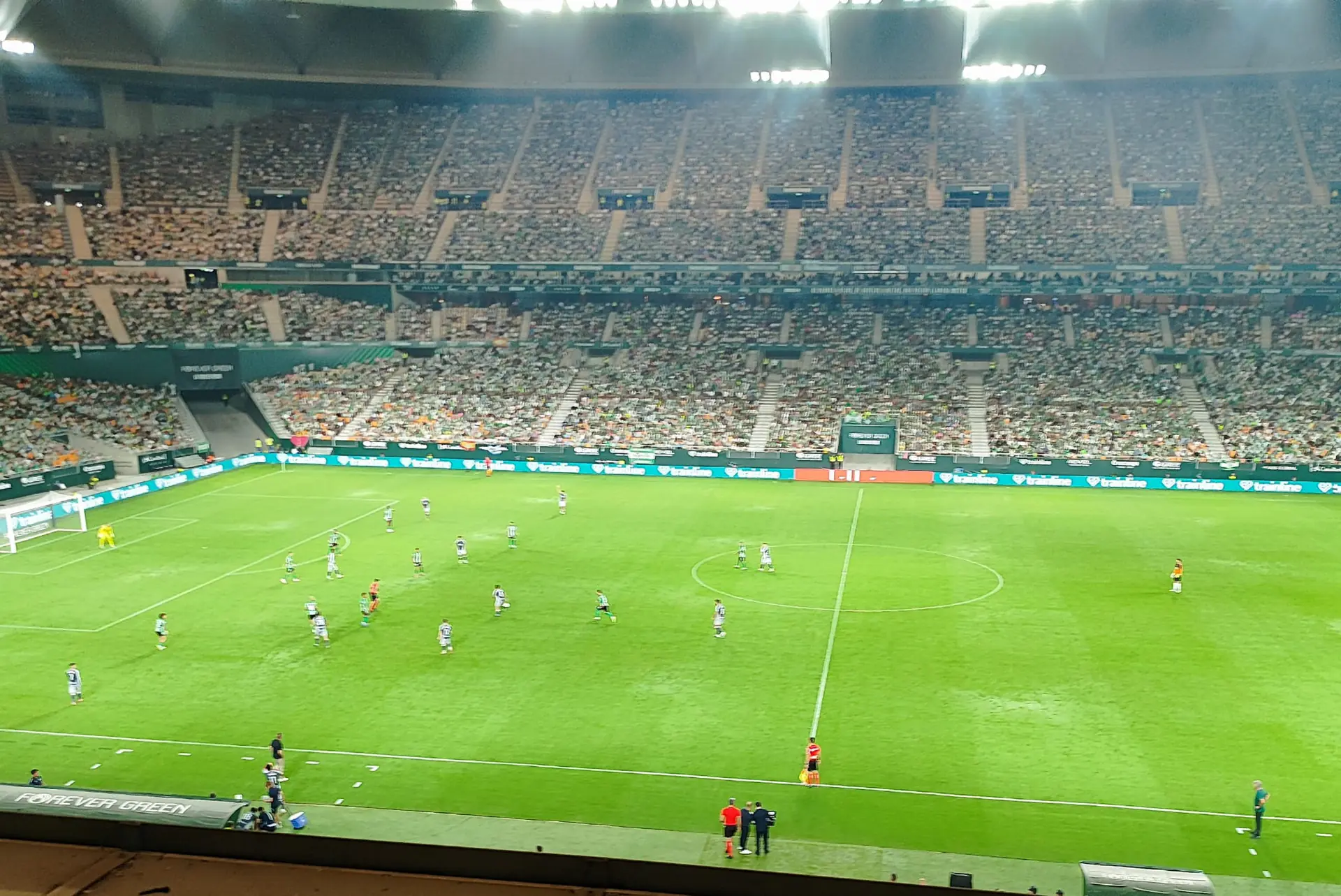
La Cartuja, officially the Estadio La Cartuja de Sevilla, is Spain's third-largest stadium and the country's main neutral venue. Built on Seville's Isla de la Cartuja for the 1999 World Championships in Athletics, it spent two decades as a cavernous athletics bowl with a running track holding spectators well back from the pitch. A rebuild completed in 2025 removed the track, dropped the pitch and added new lower tiers, turning it into a football-specific ground of 70,000 and setting it up to host matches at the 2030 World Cup. The result is a very different stadium from the one most visitors will remember, and a far better one to watch football in than the Villamarín crowd expected.
Because it belongs to the regional government rather than a club, La Cartuja works as Spain's rented big occasion: Copa del Rey finals, Spain internationals, the 2003 UEFA Cup final and Euro 2020 fixtures. It also serves as a stand-in home for Seville's clubs while their own grounds are rebuilt, which is why it currently stages far more league football than its neutral status suggests. Anchored alongside other grounds in our La Liga guide such as the Sánchez-Pizjuán and the Bernabéu.
Key Features
- ✓Capacity of 70,000, the third-largest stadium in Spain
- ✓Athletics track removed in the 2024-25 rebuild, bringing stands close to the pitch
- ✓Spain's principal neutral venue, hosting Copa del Rey finals and internationals
- ✓Selected as a host venue for the 2030 World Cup
- ✓Owned by public bodies rather than a club, so tenants change between projects
History
Built for the Track (1999)
The stadium opened on 5 May 1999, designed by the Seville practice Cruz y Ortiz Arquitectos and built for the World Championships in Athletics held that August. It was conceived as part of a bid to bring the Olympic Games to Seville, which is why it carried the name Estadio Olímpico de Sevilla for its first two decades. The athletics configuration gave it a capacity around 57,000 but placed the front rows a long way from the touchline, and the bid never succeeded.
Two Decades Looking for a Purpose
Without a permanent tenant, the ground spent years underused. Real Betis and Sevilla each considered moving in and neither did. It staged the 2003 UEFA Cup final between Celtic and Porto, occasional Spain internationals, Davis Cup ties and concerts, but for long stretches it stood largely empty, an expensive reminder of a bid that failed.
Reinvention as a National Venue
From 2020 the Spanish federation began using La Cartuja as a de facto national stadium, staging a run of Copa del Rey finals and Spain fixtures there, and it hosted matches at Euro 2020. That steady use finally gave the ground a role, and made the case for rebuilding it properly.
The 2025 Rebuild
Ahead of the 2030 World Cup, the running track was removed, the pitch lowered and new lower tiers built in the space the track had occupied. The work finished in early 2025 and lifted capacity to 70,000 while transforming sightlines: spectators now sit close to the touchline rather than behind a nine-lane track. Further work is planned before 2030.
Tickets & Tours
How to Get La Cartuja Tickets
Who sells the tickets depends on who is staging the match, which is the single most important thing to understand about this stadium.
1. Official Tickets
For a Copa del Rey final or a Spain international, tickets are sold by the Royal Spanish Football Federation through rfef.es, usually with a members' and participating-clubs presale before any general release. For a league match played here while a club is in exile, tickets come from that club instead — currently Real Betis. Prices run from about €30 in the upper bowl to €90 on the Tribuna side, and well beyond that for a final.
⚠️ Important: finals routinely sell out in the presale to the two competing clubs, so general sale can be small or non-existent. Check which club allocations apply before assuming there will be public tickets.
2. Third-Party Platforms (Sold-Out Matches)
When a fixture sells out, resale platforms list seats above face value. Verify the seller before paying, and be aware that tickets bought outside the official allocation can be voided for finals, where segregation between the two sets of supporters is strictly enforced.
Stadium Tours and Museum
La Cartuja does not run a regular public stadium tour or museum. It has no permanent tenant and no club collection to display, so there is nothing equivalent to the tours at the Bernabéu or the Sánchez-Pizjuán. Access is generally limited to matchdays and to occasional open days around major events.
If you want a stadium tour while in Seville, the club grounds across the river are the ones to book:
- GetYourGuide - Seville football and stadium experiences
- Viator - Alternative booking platform
Ticket Buying Tips
- Confirm the venue first. Fixtures move between La Cartuja and club grounds at short notice while rebuilding work continues. Check the venue on your ticket rather than assuming
- Book finals the moment presale opens, and through your club if you have an affiliation
- Bring photo ID for finals and internationals; name checks are common
- Avoid street sellers on the approach roads; counterfeits circulate around big occasions
Best Seats at La Cartuja
The 2025 rebuild changed the answer to this question completely. Before it, every seat sat behind a running track and the honest advice was to go as high as possible to compensate. Now the lower rows are genuinely close to the pitch, and the ground rewards sitting low in a way it never used to.
La Cartuja is a continuous oval rather than four separate stands, with sections numbered around the bowl. Seating is sold as Tribuna (the main side), Preferencia (the opposite side), and the two ends, Fondo Norte and Fondo Sur. Because the venue is hired by whoever is staging the match, section names and pricing change from event to event, and a Copa del Rey final is sold on an entirely different plan from a league fixture.
The Tribuna side holds the halfway line, the tunnel and the media positions, and carries the highest prices, typically €60-90 for a big fixture. Preferencia opposite gives a very similar view of play for noticeably less, usually €45-70, and is the value pick for anyone who cares more about sightlines than about being on the television side.
Tier Structure
The Lower Tier is the part created by the rebuild, filling the ground the track used to occupy. These rows are the closest to the pitch the stadium has ever had and are the best seats for atmosphere, though the shallow rake near the corners means the far touchline can feel distant. The Upper Tier is the original 1999 bowl, set higher and further back, with a steeper rake and a complete view of the pitch. It is the better choice for following shape and tactics, and for photography. The gap between the two tiers is wider than at a purpose-built club ground, a legacy of the athletics design.
Hospitality and Premium
VIP and hospitality seating sits in the central Tribuna sections, with lounge access included. Because the stadium has no permanent tenant, hospitality is packaged by the organiser of each match rather than by a club, so what is included varies from fixture to fixture. Expect €150 and upwards for a final.
Accessibility
Wheelchair positions with companion seating are provided at several points around the lower bowl, with step-free access from the surrounding esplanade, which is flat. Book through whoever is selling tickets for that specific match rather than through a club, and do it early: the allocation is finite and finals sell out.
Pro Tips
- Best value: Preferencia central, €45-70, for a view close to the Tribuna at a lower price
- Best atmosphere: the lower rows behind the goals, which the rebuild brought properly into the ground
- Best overview: Upper Tier on the halfway line, the original bowl, steep enough to read the game
- Shade matters: Seville is punishingly hot from May to September, and the roof covers only part of the seating. For an afternoon kickoff, pay attention to which side is in shade
- Check the plan every time: section naming and pricing change with the organiser, so a seat number that worked last visit may sit somewhere else entirely
Match Day Experience
Pre-Match
La Cartuja sits on the Isla de la Cartuja, the island site of the 1992 Expo, across the river from the city proper. This is not a stadium in a neighbourhood: the surroundings are science-park offices, exhibition halls and wide empty boulevards, and there is very little around the ground itself. Almost nobody starts their day here. Supporters gather instead in Triana, the district immediately across the Puente del Cachorro, or in the centre, and move across an hour or so before kickoff.
Food and Drink
Eat before you cross the river. Triana's Calle San Jacinto and the Mercado de Triana are the obvious choice, with the tapas you actually came to Seville for, and the walk to the ground from there is short. Inside, concessions are functional stadium fare, and queues at half-time are long because the concourses were built for an athletics crowd rather than a full house. If the match is in high summer, take water seriously.
Inside the Stadium
The atmosphere depends entirely on who is playing. A Copa del Rey final or a Betis league match fills the bowl and the noise is considerable now that the crowd sits close to the pitch. A sparsely sold friendly in the same building feels cavernous, and the acoustics expose it. The rebuild helped a great deal, but this is still a large oval, and it needs a full house to sound like one.
After the Match
Getting away is the weak point. The island has limited road access and a crowd of 70,000 leaves through a small number of routes, so expect a slow walk and heavy queues for buses and taxis. The usual advice is to walk back over the river towards Triana rather than wait, which takes around 25 minutes and puts you where the bars are. Cross the Puente del Cachorro or the Puente de la Barqueta and the city reopens in front of you.
Bag Policy & Prohibited Items
⚠️ Important: La Cartuja has no permanent tenant, so entry rules are set by whoever is staging the match — the Spanish federation for a final or an international, a club for a league fixture. Always check the rules published for your specific match.
As a general rule, Spanish grounds allow one small bag, roughly A4 or smaller, subject to search on entry. Larger bags are refused, and there is no bag drop or left luggage at the stadium, which matters more here than elsewhere: the ground is on an island site with almost nothing around it, so there is nowhere nearby to leave anything. If you are arriving from Santa Justa station with luggage, leave it at the station or your hotel before you travel out.
Typically prohibited: large backpacks and holdalls, glass containers and cans, alcohol brought from outside, flares and pyrotechnics, professional cameras with detachable lenses, selfie sticks, and flagpoles beyond an agreed length.
Worth bringing: mobile ticket, ID or passport for a final, a card rather than cash, sunscreen and a hat for anything kicking off in daylight between May and September, and water to drink before the search queue.
Getting There
🚇 Metro
Seville's metro does not serve La Cartuja. Line 1, the city's only line, runs east to west across the south of the city and does not cross to the Isla de la Cartuja at all, so there is no useful metro option for the stadium. The nearest stations leave you a long way short. Plans for further metro lines, including one that would improve access to the island, have been discussed for years without being built. In practice this means buses, taxis and walking are your realistic choices, and on a matchday walking across the river is often the fastest of the three. If you are arriving into Seville by train at Santa Justa, do not plan a metro connection; take a taxi or a bus, or walk into the centre and cross from there.
🚌 Bus
Tussam city buses are the main public transport to the stadium. The circular lines C1 and C2 run around the city and serve the Isla de la Cartuja, stopping on the avenues near the ground, and line C3 covers part of the same orbit. Journey times from the centre are around 15-25 minutes depending on traffic and where you board. A single ticket costs about €1.40 from the driver, and the rechargeable Tarjeta Multiviaje brings that down considerably if you are making several journeys. For major fixtures, Tussam usually runs extra services and special shuttles from the centre and from Santa Justa; these are announced in the days before the match rather than fixed year-round, so check before you travel. Buses fill up from around 90 minutes before kickoff. Afterwards is the harder part: a full house of 70,000 leaving an island site puts serious pressure on a small number of stops, and waits of 30 minutes or more are normal immediately after the final whistle. Many supporters simply walk back over the river instead.
🅿️ Parking
There is surface parking on the Isla de la Cartuja, and more of it than at most Spanish grounds, because the island was built for the 1992 Expo and retains wide roads and large open lots. Free and low-cost spaces exist along Avenida Charles de Gaulle, Avenida Leonardo da Vinci and around the science-park buildings, generally within a 10-15 minute walk of the stadium. For an ordinary fixture this is genuinely convenient. For a Copa del Rey final it is not: 70,000 people arriving at a site with limited road access creates heavy congestion on the bridges, and the lots closest to the ground fill more than two hours before kickoff. Restrictions in the business areas apply on weekdays during office hours, which rarely affects evening or weekend matches, but check signage for residents-only and reserved bays. The bigger problem is leaving. The island is reached by a handful of bridges, and after a sell-out they all back up at once; expect to sit in traffic for 45 minutes or more. If you are driving, the pragmatic approach is to park in the city, on the Triana side of the river, and walk across.
🚶 From City Center
Walking is the underrated option here, and after a big match it is often the quickest way out. La Cartuja is about 2.5 kilometres from the centre of Seville and roughly 1.5 kilometres from Triana, the district directly across the river. From Triana, cross the Puente del Cachorro and continue north-west; the walk takes about 20-25 minutes on flat ground and is well signposted on matchdays, with a steady stream of supporters to follow. From the cathedral or Plaza Nueva allow 35-40 minutes. The Puente de la Barqueta is the other main crossing and serves the northern side of the island. Both routes are flat, paved and well lit. The one serious caveat is heat: from May to September an afternoon walk across open ground with no shade is genuinely punishing, and in July and August temperatures above 40°C are routine. In those months take a bus or taxi out and walk back after dark. Taxis are plentiful in the centre and cost roughly €8-12 to the ground, but on the way back they are scarce and slow to reach the stadium; walking to Triana and picking one up there is usually faster than queueing.
Where to Stay for La Cartuja
Near the Stadium (Isla de la Cartuja)
Search hotels near La Cartuja
Be realistic about this area. The Isla de la Cartuja is a business and exhibition district, largely deserted in the evenings, and there is very little hotel stock actually beside the ground. What follows is the closest useful accommodation rather than a genuine stadium-side cluster.
Hotel Barceló Sevilla Renacimiento (1.5 km)
The closest substantial hotel, a striking circular building left over from Expo 92, on the island side of the river. Large rooms, a pool that earns its keep in summer, and a genuine walk to the stadium. The trade-off is that you are away from the city's restaurants and will be taking taxis in the evening.
Eurostars Torre Sevilla (2.0 km)
Inside the Torre Sevilla skyscraper, with the best views in the city and a shopping centre beneath. Modern, comfortable and well placed between the island and Triana, which makes it a sensible compromise for a matchday.
Hotel Ribera de Triana (2.5 km)
On the Triana riverbank, a short walk from the bridges and the tapas of Calle San Jacinto. This is the sweet spot for a match at La Cartuja: close enough to walk to the ground, and in the part of Seville you would actually want to spend an evening.
Meliá Sevilla (3.5 km)
Large, reliable hotel near the Plaza de España and the Parque de María Luisa, on the opposite side of the centre. Better for sightseeing than for the stadium, with a taxi or bus needed on matchday.
Hotel Colón Gran Meliá (4.0 km)
The grand old hotel of Seville, traditionally where visiting teams and touring bullfighters stayed. Central, expensive and the best address in the city, but firmly a sightseeing base rather than a stadium one.
City Centre and Triana (Better for Everything Else)
Search hotels in Seville City Centre
Pros:
- Everything worth eating and seeing in Seville is here, not on the island
- Triana is a 20-25 minute flat walk from the stadium over the Puente del Cachorro
- Far better choice of restaurants, bars and transport links
- Walking back after a match beats queueing for a bus on the island
Cons:
- You will walk or take a bus to the ground rather than roll out of bed
- Central prices rise sharply during Semana Santa and the Feria de Abril
- The old town can be noisy at weekends
Our Recommendation
Stay in Triana. It is the obvious answer for this stadium: close enough to walk across the river to the ground, and on the right side of the water for the tapas bars and the evening. The island has the proximity but nothing else, and the city centre has everything but the walk. Triana has both.
Frequently Asked Questions
La Cartuja holds 70,000 after the rebuild completed in early 2025, making it the third-largest stadium in Spain. It held around 57,000 before the work, when a running track separated the stands from the pitch.
No club owns it. La Cartuja is a publicly owned neutral venue used by the Spain national team and for Copa del Rey finals. It also serves as a temporary home for Seville clubs while their own grounds are rebuilt, so the team playing there changes between seasons.
Expect a limit of one small bag around A4 size, subject to search. There is no bag drop or left luggage at the stadium, and the island site has nothing nearby, so leave larger bags at your hotel or at Santa Justa station. Because the stadium has no permanent tenant, the exact rules are set by whoever is staging the match.
The metro does not serve the stadium. Take a Tussam bus on the C1 or C2 circular lines, around 15-25 minutes, or walk from Triana across the Puente del Cachorro in about 20-25 minutes. After a sell-out, walking back over the river is usually faster than queueing for a bus.
No. La Cartuja has no permanent tenant and no club museum, so it does not run regular public tours. For a stadium tour in Seville, the club grounds across the river are the ones to book.
The track was removed during the 2024-25 rebuild so the pitch could be lowered and new lower tiers built in the space it occupied. The work was done to prepare the ground for the 2030 World Cup, and it also fixed the stadium's oldest problem: spectators sitting a long way from the action.
Since the rebuild the lower tier is genuinely close to the pitch and best for atmosphere, while the original upper bowl gives the better overview. Preferencia central offers a similar view to the Tribuna for less. In summer, check which side is in shade before booking.
Triana is the best base. It sits directly across the river, a flat 20-25 minute walk from the ground, and has the tapas bars and nightlife the island completely lacks. The Isla de la Cartuja itself is a business district that empties in the evening.
Details on this page can change without much notice, and cup or European fixtures often run different rules. Last reviewed 10 August 2026 — worth confirming anything important with the club before you travel.
Related Stadiums
Other stadiums in La Liga
Tickets & Tours
Stadium Name History
Visit www.stadiumseeker.com for tickets, tours, and interactive maps