Rome, Italy
Overview
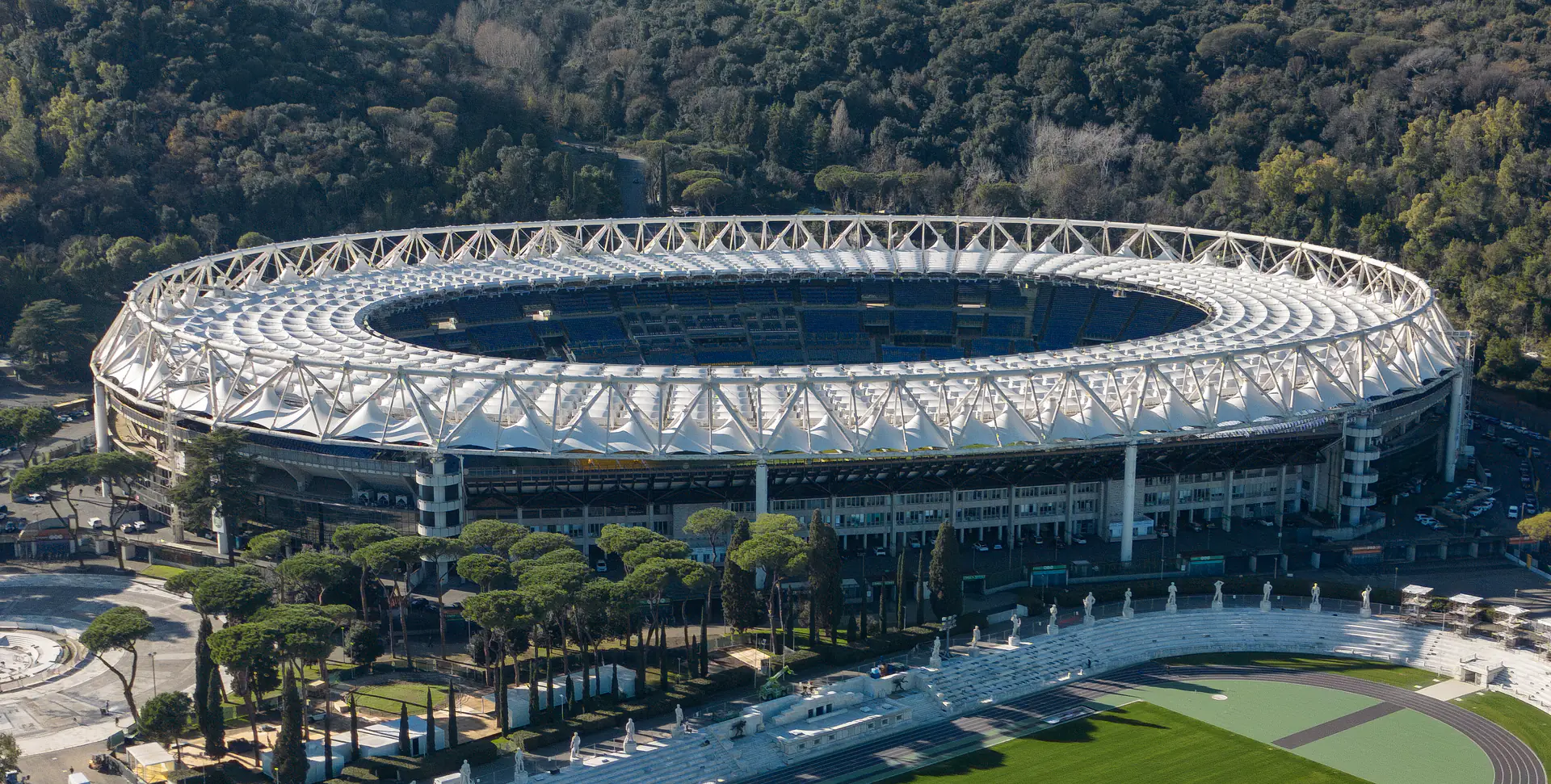
Stadio Olimpico, set within Mussolini's grand Foro Italico sports complex on the banks of the Tiber, is one of European football's most storied multi-purpose stadiums. Originally inaugurated in 1953 as the Stadio dei Centomila (Stadium of the Hundred Thousand) and substantially rebuilt for the 1990 FIFA World Cup, today it has a capacity of 70,634 — the second-largest in Italy after San Siro — and serves as the shared home of AS Roma and SS Lazio, plus the regular venue for the Italy national team and the Coppa Italia final. Few stadiums in Europe have hosted as much elite competition: it has staged the 1960 Olympic opening ceremony, the 1990 World Cup final (West Germany 1-0 Argentina), four UEFA Champions League finals (1977, 1984, 1996, 2009) and the opening match plus a quarter-final of UEFA Euro 2020/2021.
Located about 5 km north-west of Rome's historic centre, the Olimpico is also the cathedral of the Derby della Capitale — the city derby between Roma and Lazio, recognised as one of football's most intense local rivalries. The stadium is part of a broader sports city that includes the Foro Italico tennis complex (host of the Italian Open) and a 1930s marble-clad Mussolini-era architectural ensemble that is itself a Roman landmark. With both Roma and Lazio working through long-term plans for new club-owned stadiums, the Olimpico continues to anchor Rome's footballing identity for the foreseeable future. Whether you're attending a Sunday-night Roma fixture under floodlights, a Lazio Champions League match, or watching Italy at home — and however the visit compares to a trip to Maradona in Naples or Allianz Stadium in Turin — the Olimpico delivers a distinctly Italian matchday: sun, scarves, and operatic singing under the curva.
Key Features
- ✓Shared home of AS Roma and SS Lazio plus regular venue of the Italy national team
- ✓Capacity 70,634 — second-largest stadium in Italy after [San Siro](/en/stadiums/san-siro)
- ✓Hosted the 1990 FIFA World Cup final and four UEFA Champions League finals (1977, 1984, 1996, 2009)
- ✓Cathedral of the Derby della Capitale — Roma vs Lazio
- ✓Set within the Mussolini-era Foro Italico complex; opening match of UEFA Euro 2020 played here in 2021
History
Construction of what was then called the Stadio dei Centomila began in the late 1930s as part of Mussolini's Foro Italico sports city, but was halted by World War II and only completed in 1953 to a design by Annibale Vitellozzi. The original capacity was around 100,000 (largely standing) and the stadium initially had no roof. Both AS Roma and SS Lazio adopted it as their home from 1953 onwards, replacing earlier grounds (Roma's Campo Testaccio and Lazio's Stadio Nazionale).
The 1960 Rome Olympics
In 1960 the stadium hosted the opening and closing ceremonies of the XVII Summer Olympic Games — the events that gave the venue its current name. The 1960 Olympics also produced one of the most famous moments in athletics history when Abebe Bikila of Ethiopia won the marathon barefoot, finishing under the Arch of Constantine.
Champions League Heritage
The Olimpico has hosted four European Cup/Champions League finals: Liverpool 3-1 Borussia Mönchengladbach (1977), Liverpool 1-1 Roma (1984, won by Liverpool on penalties — a particularly painful Roma memory), Juventus 1-1 Ajax (1996, lost on penalties), and Barcelona 2-0 Manchester United (2009). UEFA Euro 1968 and Euro 1980 finals were also held here, as were the opening match and a quarter-final of Euro 2020 (rescheduled to 2021).
The 1990 World Cup Rebuild
For the 1990 FIFA World Cup, the Olimpico was almost completely rebuilt to a design by Studio Vitellozzi — the previous structure was largely demolished, a new roof was added covering the entire seating bowl, and capacity was reduced to roughly 73,000 all-seated. The venue hosted six matches including West Germany's 1-0 final win over Argentina. After UEFA introduced new safety standards in the late 1990s, capacity was further reduced to the current 70,634.
European Adventures of Roma and Lazio
Both Roman clubs have produced memorable European nights at the Olimpico. AS Roma reached the European Cup final in 1984 (lost on penalties at home to Liverpool), the UEFA Cup final in 1991, and most recently won the inaugural UEFA Conference League in 2022 under José Mourinho — a result that triggered scenes of celebration along the Tiber. SS Lazio won the UEFA Cup Winners' Cup in 1999 and the 2000 Scudetto in a season climaxed at the Olimpico. The 2003-04 era under Sven-Göran Eriksson and Cesare Maldini, the Totti-Cassano Roma of the early 2000s, and Lazio's Mourinho-era resurgence have all made the venue a regular European football fixture.
The New-Stadium Question
Both Roma and Lazio have long pursued plans to build new club-owned stadiums. Roma's Stadio della Roma project at Pietralata, north-east of the city, advanced through urban planning approvals in 2024-25 and is the more developed proposal. Until any new venue opens, the Olimpico remains the heart of Roman football — and given the historical and architectural importance of the Foro Italico complex, it will continue to host the Italy national team and the Coppa Italia final for the foreseeable future.
Tickets & Tours
How to Get Roma and Lazio Tickets
There are three main ways to attend a match at the Stadio Olimpico:
1. Official Club Tickets (Best Value)
Buy directly from each club, depending on which is the home team:
- AS Roma: asroma.com/en/tickets — general sale opens 2-3 weeks before kickoff
- SS Lazio: sslazio.it/en/tickets — general sale opens 2-3 weeks before kickoff
- Italy national team: vivaticket.com — sale typically 3-4 weeks before match
Prices range from €30 (Curva upper corners) to €150+ (Tribuna Tevere central). Italian rules require nominative tickets with a matching photo ID. Roma's 'Romulus' membership and Lazio's 'Aquile' membership unlock earlier sales windows.
⚠️ Important: Derby della Capitale, Champions League/Europa League knockouts and visits from Inter, Milan, Juventus and Napoli sell out before general sale.
2. Official Hospitality (Guaranteed Access)
Both clubs offer hospitality at the Olimpico — the most reliable route to derbies and European knockouts:
- AS Roma: Tribuna Monte Mario VIP, Premium Tevere — packages from €280
- SS Lazio: Tribuna Tevere Premium, Sky Box — packages from €260
Book via each club's hospitality team; corporate groups should contact the clubs directly.
3. Third-Party Platforms (Sold-Out Matches)
For sold-out fixtures, established platforms aggregate verified resale:
- LiveFootballTickets — Serie A specialists, from €80
- SeatPick — comparison platform across multiple sellers
⚠️ Note: Italian nominative-ticket rules mean some resale tickets cannot be legally transferred. Always verify the seller can re-issue the ticket in your name.
Stadio Olimpico Tour
The Stadio Olimpico Tour is a relatively low-key experience compared to the dedicated club museums at Camp Nou or Allianz Stadium, as the Olimpico is shared. However, both Roma and Lazio operate experiences at the stadium plus their own training-ground museums and tours.
What's Available
- Foro Italico guided walks covering the 1930s architectural ensemble, the marble-clad Stadio dei Marmi, and the Olimpico's exterior
- AS Roma Stadium Tour when arranged by the club — pitch-side, dressing rooms, tunnel access; offered around big home matches
- SS Lazio museum and tour at Formello (training ground) and at the stadium
- Italy national team experiences offered by FIGC around home internationals
Practical Details
- Schedule: Tour availability is irregular — check each club's official website close to your visit
- Price: €15-25 depending on operator and inclusions
- Languages: Italian, English (variable)
- Accessibility: Generally accessible; confirm in advance
Booking
- GetYourGuide — Foro Italico walks from €15
- Viator — combined experiences from €20
- AS Roma: asroma.com/en/stadium-tour
- SS Lazio: sslazio.it
Pro tip: If you want a deep stadium tour experience around your visit, consider pairing the Olimpico with a day-trip to Allianz Stadium in Turin or Maradona in Naples — both have richer dedicated museum offerings.
Quick Tips
- Bring photo ID: Tickets are nominative; mismatched names will be refused
- Big matches: Derbies and European knockouts rarely reach general sale
- Public transport: Tram 2 and dedicated matchday buses are the easiest options
- Avoid touts: Counterfeit nominative tickets are a known problem outside Foro Italico
- Pair with sightseeing: The walk back along the Tiber to central Rome is one of the great post-match strolls in European football
Best Seats at Stadio Olimpico
The Olimpico is a single-tier (with mezzanine) oval bowl with the running track between the stands and the pitch — a layout shared with most multi-purpose European stadiums of its era. The Tribuna Tevere central sections offer the best balance of view, atmosphere and price. Read on for the breakdown by stand.
Curva Sud (South End)
The most iconic stand at the Olimpico — historically the home end for the Roma ultras when Roma is the home team, and the away end for Lazio when Lazio is at home. Distinta Sud Curva sections behind the goal are the loudest. Curva Sud prices typically €30-50 for Serie A. The atmosphere is unmatched in Italian football alongside San Siro's curve.
Curva Nord (North End)
The traditional Lazio ultras end (when Lazio is at home, vice-versa for Roma). Same architectural pattern as the Curva Sud. Prices €30-50. Both curve are known for elaborate tifos in the Derby della Capitale.
Tribuna Tevere (Long Side, East — Tiber Side)
The Tribuna Tevere runs along the long side closest to the river. Sections Tevere Centrale, Parterre and Tevere Top offer excellent halfway-line views. Pricing roughly €55-100 (lower), €45-80 (upper), with central sections being most expensive. The Tribuna Tevere is the focal point of TV cameras.
Tribuna Monte Mario (Long Side, West)
The Tribuna Monte Mario runs along the long side opposite the Tiber, with views toward Monte Mario. Sections include Monte Mario Centrale and Monte Mario Lateral. Pricing similar to Tribuna Tevere (€50-100). The dressing-room tunnel and dugouts are at the south end of this stand.
Tribuna Autorità & Premium
The Tribuna Autorità central section behind the dugouts hosts dignitaries, sponsors and hospitality areas. Premium hospitality runs from around €220 to €500+ for the Derby della Capitale. Each club operates its own hospitality programme depending on the home team.
Accessibility
Wheelchair-accessible seating is available across multiple sections with companion seats. Lift access between levels is provided. Contact the home club's accessibility desk in advance.
Pro Tips
- Best atmosphere: Curva Sud (Roma home) or Curva Nord (Lazio home), lower section
- Best balance: Tribuna Tevere central, lower mezzanine
- Best photographs: Tribuna Tevere upper — the curva tifos and Monte Mario hills frame beautifully
- Away fans: Allocated section in the opposite curva upper tier
- Derby della Capitale: Tickets sell out instantly to members; expect to use hospitality
- Italy matches: Tribuna Tevere central is the focal point — book early via vivaticket.com
Match Day Experience
A matchday at the Stadio Olimpico is one of European football's great atmospheric experiences — Roma or Lazio singing under the Roman sky, the Foro Italico's marble around you, and the curva tifos matching the city's theatrical character.
Pre-Match (2-3 hours before)
The matchday begins around the Foro Italico complex and along Lungotevere Maresciallo Cadorna by the Tiber. The Ponte Duca d'Aosta bridge is the main pedestrian approach from the Flaminio side; the Stadio dei Marmi (with its iconic marble statues) sits just outside the stadium and is part of the pre-match walk. Pre-match bars and restaurants cluster along Via di Villa Madama, Piazza Mancini and Piazza della Libertà. Try Bar Stadio at Lungotevere or the canteens around Piazza Mancini for an authentic Roman pre-match. The atmosphere is theatrical and unmistakably Roman — espressos and supplì (rice balls) until 30 minutes before kickoff.
Inside the Stadium
Gates open roughly 90 minutes before kickoff. Both Roma and Lazio matches feature elaborate pre-match displays, but the Derby della Capitale tifos — particularly from the Curva Sud (Roma) and Curva Nord (Lazio) — are among the most spectacular in European football. Roma fans sing 'Roma Roma Roma', 'Forza Roma', and the iconic 'Grazie Roma' by Antonello Venditti. Lazio fans answer with 'Vola Lazio Vola' and 'Lazio nel cuore'. Both clubs' anthems are performed before kickoff with scarves raised across the bowl.
Food & Drink
Concession kiosks sell traditional Roman matchday fare — supplì (deep-fried rice balls), panini con porchetta (roast pork rolls), pizza al taglio, plus Peroni and Moretti. Prices are reasonable (around €5-7 for panino + drink). Hospitality areas in the Tribuna Autorità offer Roman antipasti and plated dining.
After the Match
Post-match crowds funnel toward Piazzale della Farnesina and the bus interchange, plus the Lungotevere for those walking back to the centre. Allow 20-30 minutes for crowds to clear. For dinner, Prati, Borgo (near the Vatican) and Trastevere all stay lively until late. The Foro Italico itself empties quickly post-match.
International Visitor Tips: Italian rules require nominative tickets matched to a photo ID. The walk back from the Olimpico along the Tiber on a clear evening is one of football's underrated experiences — head south toward Castel Sant'Angelo and you'll be in central Rome in 30-40 minutes on foot. Combine with a morning at the Foro Italico complex (Stadio dei Marmi, fascist-era architecture, Italian Open courts) for context.
Bag Policy & Prohibited Items
⚠️ Important: the Stadio Olimpico is stricter than most Italian grounds, and the rules are the same whether Roma or Lazio are at home.
Nothing bigger than A4. Backpacks and bags above A4 format are refused outright, and there is nowhere at all to leave luggage — no deposit, no lockers, no cloakroom. Arriving from Termini with a bag is the classic mistake here; leave it at the station or your hotel.
Bring photo ID. You need a valid match ticket and a valid identity document to get in, and stewards check the two against each other. Enter at the time printed on your ticket, which the club asks for specifically to stop crowding at the gates.
Unusually, food is allowed — sandwiches and pizza are fine — but drinks are not, in any bottle or container. Power banks and lighters are refused, which catches people out, as does smoking: it is banned in every area of the ground, not just the stands.
Getting There
🚇 Metro
Rome's Metro doesn't reach the Olimpico directly. The closest option is Metro Line A (Orange) to Flaminio, then change to the Roma-Viterbo regional train to Piazza Apollodoro (the next stop), then a 15-minute walk. Alternatively, take Metro A to Ottaviano (near the Vatican) and switch to bus 32 or 990 north along the Tiber. Total journey from Termini ~30-40 minutes.
🚌 Bus
Multiple buses serve the Foro Italico complex on matchdays. Routes 32, 48, 69, 186, 224, 226, 280, 301, 910 and 990 stop on Piazza Mancini, Piazza Maresciallo Giardino or directly outside the stadium. ATAC dedicated matchday shuttles also operate from Termini and Tiburtina stations. Tram 2 from Piazzale Flaminio is the fastest and most reliable option, ending at Piazza Mancini — a 10-minute walk to the stadium.
🅿️ Parking
Limited parking at Foro Italico on matchdays — much of the surrounding area is closed to non-residents. The largest options are Parcheggio Acqua Acetosa (M2 Acqua Acetosa, €5-10) and various private lots in Prati (€10-15) with bus connections. Public transport is strongly recommended.
🚶 From City Center
From central Rome (Piazza del Popolo or Piazza di Spagna), the Olimpico is a 40-50 minute walk along the Tiber via Ponte del Risorgimento and Lungotevere — a classic Roman pre-match stroll on dry days. From Termini, it's roughly 6 km — too far to walk for most. A taxi from the centre costs around €15-22; expect higher on matchday. Uber and FreeNow operate in Rome.
Where to Stay for Stadio Olimpico
Near the Stadium (Foro Italico / Flaminio)
Search hotels near Stadio Olimpico
The immediate Foro Italico area is residential, sporty and quiet. Most visitors prefer staying in central Rome or the Prati district just south of the stadium for the better restaurants and walking access to the Vatican and historic centre.
Hotel degli Aranci (Parioli, 2 km)
Four-star villa-style hotel in the upmarket Parioli district just south of Foro Italico. Walking distance to Villa Borghese and a 25-30 minute walk to the stadium along the Tiber. Quiet, elegant, popular with corporate visitors.
Prati (Recommended for Match-Focused Visits)
Search hotels in Prati
The Prati district just south of the stadium combines walking distance to St. Peter's Basilica, the Vatican Museums and Castel Sant'Angelo with a 30-35 minute walk along the Tiber to the Olimpico. The area has excellent restaurants, the daily Trionfale market, and direct metro access (Line A) to the rest of Rome.
Hotel Atlante Star (Prati)
Four-star with rooftop terrace overlooking St. Peter's. Walking distance to the Vatican and the Olimpico (35-minute walk) along the Tiber. Excellent breakfast, dependable service.
The Building Hotel (Prati)
Design-led four-star with stylish rooms and rooftop bar. Excellent location between the Vatican and Piazza del Popolo. Younger feel than the more traditional Roman hotels.
Centro Storico (Recommended for Most Visitors)
Search hotels in central Rome
For most visitors balancing football with sightseeing, central Rome around the Pantheon, Piazza Navona, or Trastevere is the better base — the matchday walk along the Tiber is a highlight in itself, and Rome's restaurants and historic centre are unmatched.
Hotel de Russie (Piazza del Popolo, 4 km)
Five-star Rocco Forte property at Piazza del Popolo with secret garden and Stravinskij Bar. The benchmark luxury option in Rome and ideally placed for the matchday walk along the Tiber to the Olimpico.
Hotel Eden (Spanish Steps, 5 km)
Five-star Dorchester Collection above the Spanish Steps. Rooftop bar with panoramic views, exceptional service. A serious 5-star choice for combining football with high-end Roman tourism.
Our Recommendation
For most visitors, stay in central Rome (Centro Storico, Trastevere or Prati). The matchday walk along the Tiber is one of football's underrated experiences and Rome's restaurants and historic sites are far better explored from a central base. Stadium-area hotels make sense only for purely match-focused trips, and even then Prati offers a better balance than Foro Italico itself.
Frequently Asked Questions
Roma and Lazio tickets at the Olimpico typically range from €30 (Curva upper corners) to €150+ (Tribuna Tevere central). Derby della Capitale, Champions League/Europa League knockouts, and visits from Inter, Milan, Juventus or Napoli are heavily oversubscribed and often only available via hospitality (from ~€260) or the secondary market. Italy national team tickets typically run €30-120.
Buy directly from the home club for that match — asroma.com for Roma fixtures, sslazio.it for Lazio fixtures, vivaticket.com for Italy national team matches. Italian rules require nominative tickets matched to a photo ID, so the secondary market is risky unless the seller can legally re-issue the ticket in your name.
Tours of the Olimpico itself are less developed than at dedicated club stadiums like Allianz Stadium or Camp Nou — the Olimpico is shared between Roma and Lazio, so neither runs a permanent club museum on-site. AS Roma offers stadium tours around big home matches, and the broader Foro Italico complex (Stadio dei Marmi, fascist-era architecture) can be visited via guided walks. SS Lazio runs a separate museum at Formello training ground.
The Derby della Capitale is the Rome derby between AS Roma and SS Lazio — both founded in the early 20th century and both based in the city since their inception. Played at the Olimpico since both clubs adopted it in 1953, the derby is one of football's most intense local rivalries, famous for elaborate Curva Sud and Curva Nord tifos. As the two clubs share the stadium, the curva allocations swap depending on which is the technical home team.
No backpack or bag larger than A4 format, and there is nowhere at the Stadio Olimpico to leave luggage — no deposit or lockers of any kind. You also need a valid photo ID alongside your ticket. Food such as sandwiches and pizza is allowed, but drinks in bottles or containers are not, and power banks and lighters are refused.
Tram 2 from Piazzale Flaminio to Piazza Mancini (then 10-minute walk) is the fastest and most reliable matchday option. Multiple buses (32, 48, 69, 186, 224, 280, 301, 910, 990) also serve the Foro Italico. From Termini, ATAC runs dedicated matchday shuttles. Walking from central Rome along the Tiber takes 40-50 minutes and is part of the Roman matchday tradition.
For most visitors, central Rome (Centro Storico, Trastevere) or the Prati district near the Vatican is the best base — the matchday walk along the Tiber is a highlight in itself, and Rome's restaurants and historic centre are unmatched. Stadium-area hotels in Foro Italico or Parioli make sense only for purely match-focused trips.
Stadio Olimpico has a capacity of 70,634, making it the second-largest stadium in Italy after San Siro in Milan. The current capacity dates from a 1990 World Cup rebuild followed by post-2000 safety reductions; the original 1953 stadium held over 100,000 standing.
Details on this page can change without much notice, and cup or European fixtures often run different rules. Last reviewed 9 August 2026 — worth confirming anything important with the club before you travel.
Related Stadiums
Other stadiums in Serie A
Tickets & Tours
Stadium Name History
Visit www.stadiumseeker.com for tickets, tours, and interactive maps