Munich, Germany
Overview
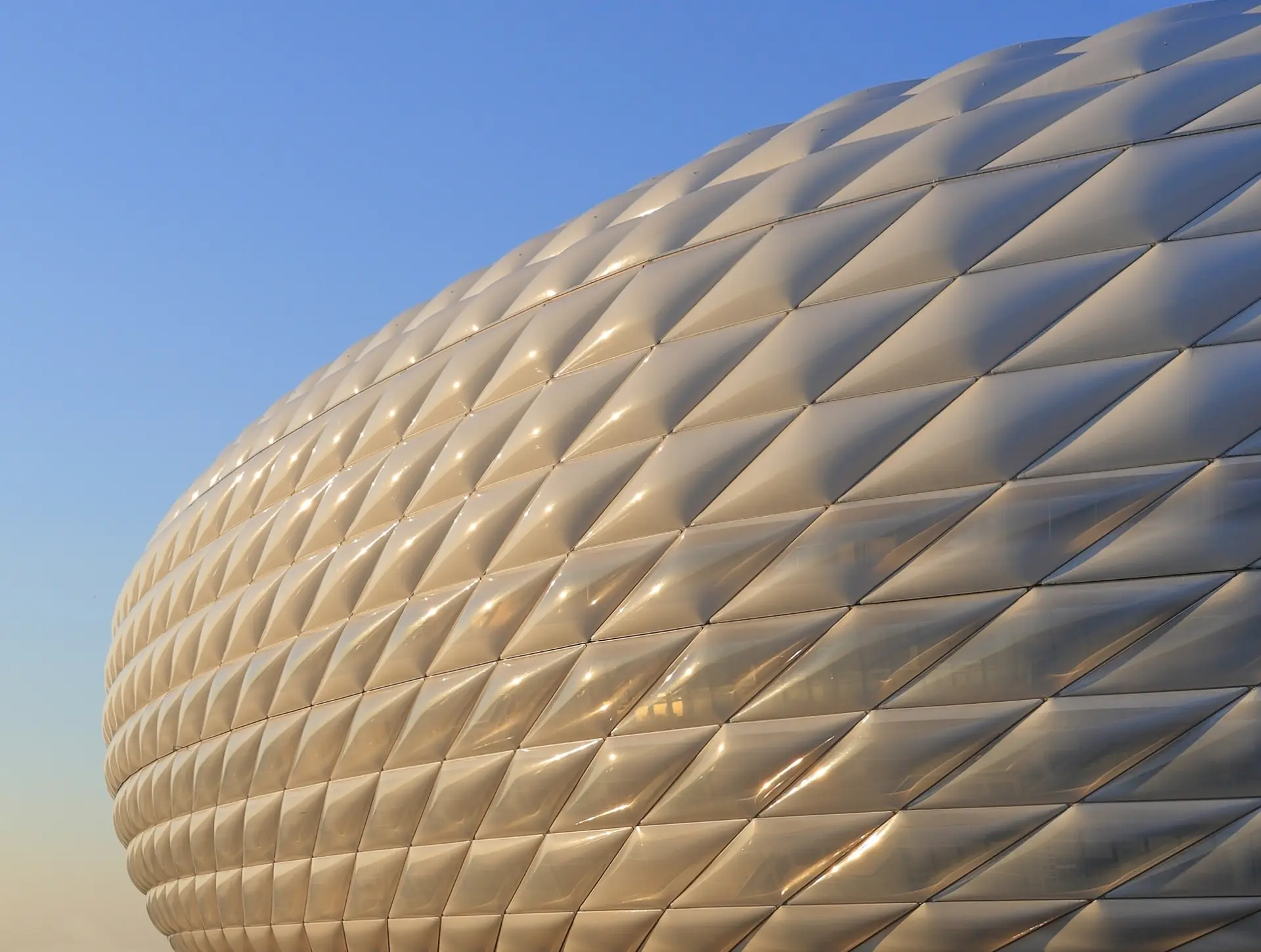
Allianz Arena is the home of FC Bayern München and one of the most recognisable buildings in world football. Opened in 2005 to a design by Swiss architects Herzog & de Meuron, it is wrapped in more than 2,700 inflated ETFE plastic panels that can be lit independently — the exterior glows red for Bayern matches, white for German national team fixtures and, occasionally, in other colours to mark a particular occasion. Approaching it across the Esplanade at dusk, with the whole shell shifting colour above the plain, is one of the sport's genuine architectural moments.
Bundesliga capacity is 75,024, dropping to roughly 70,000 for UEFA competitions where standing areas must be converted to seats. The ground sits on the Fröttmaninger Heide at the northern edge of Munich, deliberately away from the city centre and served by its own U-Bahn station. Bayern have sold out every league match here since January 2007, which shapes everything about visiting: tickets are the hard part, not the logistics. Alongside Signal Iduna Park, it anchors any tour of German football.
Key Features
- ✓Illuminated ETFE panel facade by Herzog & de Meuron — the exterior changes colour
- ✓Bundesliga capacity 75,024, reduced to about 70,000 for all-seated UEFA matches
- ✓The Südkurve — blocks 109 to 117, Bayern's standing home end
- ✓Every Bundesliga home match sold out since January 2007
- ✓Its own U-Bahn station at Fröttmaning, plus Europe's largest stadium car park complex
History
Bayern spent most of their modern history sharing the Olympiastadion, the 1972 Olympic ground with its celebrated tented roof but poor sightlines and a running track separating supporters from the pitch. A 2001 Munich referendum approved a new, football-only stadium, and construction began in 2002 on the Fröttmaninger Heide beside the A9 motorway.
A Shared Build
The arena opened in 2005 as a joint home for Bayern and TSV 1860 München, who had been the city's other major club. 1860 took a 50% stake, then sold it to Bayern in 2006 under financial pressure, and left the ground entirely in 2017. What was designed as a two-club stadium has been Bayern's alone ever since — which is why the exterior, originally able to glow blue for 1860, is now seen almost exclusively in red.
The Building
Herzog & de Meuron's design is deliberately simple in plan — a continuous three-tier bowl with no corners cut away, so the crowd wraps unbroken around the pitch — and radical in its skin. The ETFE cushions are inflated and individually lit, making the facade a display surface rather than a wall. It was the first stadium in the world with a full colour-changing exterior.
Matches and Moments
The arena hosted the opening match of the 2006 FIFA World Cup, six matches at UEFA Euro 2024, and the 2012 UEFA Champions League final — in which Bayern lost on penalties to Chelsea in their own stadium, a night still referred to in Munich as the Finale dahoam. It also hosted the 2025 Champions League final. Domestically it has been the setting for the most sustained period of dominance in Bundesliga history.
Tickets & Tours
How to Get FC Bayern Tickets
Be realistic: every Bundesliga home match has sold out since January 2007. Getting in takes planning.
1. Official Club Tickets
Bayern release tickets through fcbayern.com in advance of each match. General public allocation is small — most seats go to members and season-ticket holders first, and popular fixtures never reach open sale. Prices are notably low by European standards for a club of this size, with standing places among the cheapest in elite football and seated tickets typically ranging from around €35 to €100+ depending on tier and opponent.
⚠️ Important: Club membership improves your odds considerably and is inexpensive, but it is not a guarantee. Apply for ballots as early as they open.
2. Official Hospitality
Guaranteed access, at a price. Bayern's hospitality packages include seating in the middle tier with catering and lounge access, and are usually available when ordinary tickets are not. Book through the club's official hospitality channels.
3. Cup and Friendly Fixtures
DFB-Pokal rounds and pre-season matches are markedly easier to attend than league games and offer the same building and much of the same atmosphere. For a first visit, these are a sensible target.
Third-Party Platforms
Resale sites list Bayern matches, and we deliberately do not link to them. Bayern operate personalised ticketing on many fixtures: the name on the ticket is checked, and entry is refused when it does not match. Resold tickets are also routinely priced far above face value for a club whose own prices are among the lowest in elite football. If the official channels and hospitality are both closed to you, a cup match or a stadium tour is a better use of the trip than a resale gamble.
⚠️ Note: Munich has an active market in resold tickets; Bayern operate personalised ticketing for many matches and do refuse entry where names do not match. Treat any unofficial offer with caution.
Stadium Tours & FC Bayern Museum
The Allianz Arena tour and the FC Bayern Museum share the site, and the museum is one of the best club museums in Europe — large, well-curated and generous with actual objects rather than screens.
What You'll See
- The players' tunnel and pitchside
- Dressing rooms and warm-up areas
- The press conference room
- Views from the upper tier across the bowl
- The FC Bayern Museum, covering the club from its 1900 founding through the Beckenbauer era to the present, including the treble seasons
Practical Details
- Duration: Guided arena tour approximately 60 minutes; allow a further 1-2 hours for the museum
- Price: Combined museum and arena entry from around €19; full guided tours around €48 for adults and €28 for children, with under-3s free
- Schedule: Daily outside matchdays and event days; guided tours run to a timetable and sell out in summer
- Languages: German and English
- Accessibility: Step-free throughout
Booking
- GetYourGuide — arena and museum tickets
- Viator — tour experiences
Pro tip: Book the guided tour rather than self-guided entry if you want pitchside and dressing-room access, and go on a weekday morning to avoid the coach parties.
Quick Tips
- Sold out since 2007 — plan months ahead, not weeks
- Cup matches are the realistic route in for most visitors
- Museum alone is worth the trip if you cannot get a match ticket
- Bring ID matching your ticket where personalisation applies
Best Seats at the Allianz Arena
The bowl is a clean three-tier design and there are genuinely no obstructed views, so the choice is about atmosphere and budget rather than sightlines.
Südkurve (South Curve) — blocks 109-117
Bayern's home end and the heart of the noise. This is standing for Bundesliga matches, using folding seat units that stack into the steps and are reassembled for UEFA fixtures. Tickets here are the cheapest in the ground and by far the hardest to obtain — they go to members and long-standing supporters. If you get one, expect to stand for ninety minutes among organised singing and flag displays.
Lower Tier sidelines
The closest you can sit to the pitch. Central blocks command the highest prices; corner blocks are noticeably cheaper for a view that is still excellent. Good choice if you want proximity over panorama.
Middle Tier
The best all-round compromise, and what most neutrals should target. High enough to read the shape of the game, close enough to feel it, and it includes the business and hospitality areas along the sides.
Upper Tier
Steep and high, with a complete view of the pitch — genuinely good for watching the tactical picture, and the cheapest seated option. The rake is severe, which is worth knowing if you are uneasy with heights.
Nordkurve (North Curve)
Opposite the Südkurve, and where the away allocation sits. Atmosphere is good without matching the south end.
VIP & Hospitality
The middle tier carries the business seats, lounges and boxes, and this is where Bayern's hospitality packages sit. They are expensive, but they are also frequently the only route into a sold-out fixture, and they include catering and lounge access before and after the match. Book through the club's official hospitality channels.
Accessibility
Wheelchair spaces are distributed around the lower tier with companion seating alongside, and the arena has step-free access throughout via lifts and ramps from the Esplanade. Book accessible places directly with the club well in advance.
Pro Tips
- Best atmosphere: Südkurve, if you can get in — otherwise the lower blocks nearest it
- Best value: upper tier corners
- Best overall view: middle tier, halfway line
- Away fans: Nordkurve, with a separate approach path from Fröttmaning
Match Day Experience
A Bayern matchday is efficient in a way that surprises visitors used to older grounds — the whole site was designed around moving 75,000 people in and out quickly.
Getting In
Gates open around two hours before kickoff, and it is worth using them. The Esplanade between the U-Bahn station and the arena is a long, deliberate approach, and the walk is part of the experience. Tickets are largely digital via the FC Bayern app.
Before the Match
There is no traditional pub district around the ground — it sits on open heathland, not in a neighbourhood. Most supporters drink and eat in the city first, then travel out. On the Esplanade and inside the plaza you will find beer and food stands; inside, the arena serves Bavarian staples — bratwurst, pretzels, and beer in the arena's own branded cups, with a deposit refunded on return.
Food & Drink
Inside, the arena serves Bavarian staples — bratwurst, pretzels and beer, poured into the arena's own reusable cups against a deposit that is refunded when you hand them back. Queues at the concourse kiosks are heaviest in the ten minutes before kickoff and at half time. Card payment is accepted throughout and is faster than cash.
Inside the Stadium
The Südkurve leads the singing, with organised chants and frequent large flag displays before kickoff. The roof traps sound well for a modern bowl, and big European nights are considerably louder than a routine league fixture. Bayern's dominance means many league matches are settled early, and the crowd can go quiet accordingly — this is a stadium that comes alive against real opposition.
After the Match
The U6 absorbs the crowd remarkably well, but expect queues at Fröttmaning for the first twenty minutes or so. Many visitors walk part of the way or simply wait on the plaza until it thins. Trains run late into the evening back to the centre, where Schwabing and the area around Leopoldstraße stay open for food and drink.
International Visitor Tips: Munich is comfortable for non-German speakers and the arena signage is bilingual. Match tickets are the genuine obstacle — see the ticket guide below. If you cannot get a league ticket, the stadium tour is excellent and the DFB-Pokal rounds are usually easier to attend.
Bag Policy & Prohibited Items
⚠️ Important: Bags larger than A4 size are not permitted inside the Allianz Arena. This is enforced consistently and is the single most common reason visitors are turned away at the gate.
Currently allowed:
- Small handbags and pouches within A4 dimensions
- Phones and compact cameras
- Soft banners and flags without poles
- Essential medication
Prohibited:
- Backpacks, rucksacks and suitcases of any size
- Bottles, cans and outside drinks
- Flares, fireworks and pyrotechnics
- Umbrellas with pointed tips
- Professional camera equipment with detachable lenses
Storage: The arena operates a luggage store near the entrances, charging around €2 per item, which is the practical answer for anyone arriving straight from the airport or a hotel checkout. It queues heavily right before kickoff, so use it early.
Security: Searches are thorough and there are several separate checks between the Esplanade and your block. Allow 45-60 minutes between arriving at Fröttmaning and reaching your seat on a full-house matchday, and confirm current rules on the club's official site before travelling, as concert and international-fixture rules differ from Bundesliga ones.
Getting There
🚇 Metro
The U6 is the way in, and it is excellent. Take it northbound towards Garching-Forschungszentrum and alight at Fröttmaning, roughly 16 minutes from Marienplatz in the city centre. From the station it is a 10-15 minute walk along the raised Esplanade to the arena, with the building in view the whole way. Trains run every few minutes and are heavily reinforced on matchdays. A Munich MVV day ticket covers the journey, and match tickets do not include travel.
🚌 Bus
Buses are not the practical choice for the arena — the U6 carries the overwhelming majority of supporters and is far quicker. Local services do run to the Fröttmaning area, but on a matchday the U-Bahn is both faster and better organised.
🅿️ Parking
The arena sits above four large multi-storey car parks, together among the biggest stadium parking complexes in Europe, directly beneath the plaza between the U-Bahn station and the ground. Matchday parking costs around €10, and the first structure opens at 08:00. Registering your number plate with the club in advance speeds entry considerably. Car parks close about four hours after full time. By road, use the A9 motorway: exit Fröttmaning-Nord (73) from the north or München-Fröttmaning-Süd (74) from the south. Expect substantial queues to exit after a sell-out.
🚶 From City Center
The arena is around 10 km north of Munich city centre, so walking the whole way is not realistic. The walk that matters is the Esplanade from Fröttmaning station — a wide, gently rising pedestrian avenue that takes 10-15 minutes and delivers the classic first view of the illuminated facade. Away supporters are directed along a separate footpath on the far side of the U-Bahn tracks.
Where to Stay for the Allianz Arena
Near the Stadium
Search hotels near the Allianz Arena
The arena stands on open heathland at the city's northern edge, and there is no hotel district around it. A handful of business hotels sit in the northern suburbs near the U6 line, which suits anyone who wants a short journey and nothing else, but there is little to do on foot.
Schwabing (Recommended)
Search hotels in Schwabing
The best balance for a football trip. Schwabing sits directly on the U6, putting the arena a straightforward ride away, and it is Munich's most enjoyable district for eating and drinking — leafy streets, long-standing beer gardens, and the Englischer Garten on the doorstep. Around Leopoldstraße you are well placed for both the stadium and the city.
City Centre / Altstadt
Search hotels in Munich city centre
Staying around Marienplatz or Hauptbahnhof puts you among Munich's sights — the Residenz, the Viktualienmarkt, the great beer halls — with a direct U6 connection from Marienplatz to the ground. Prices are highest here, and rise sharply during Oktoberfest and major trade fairs, when the whole city sells out.
Our Recommendation
Stay in Schwabing if the football is the point of the trip: it is on the right U-Bahn line, it is pleasant to come back to after a match, and it is cheaper than the Altstadt. Choose the city centre if you are combining the match with sightseeing and do not mind paying for it.
Book early for any weekend fixture, and much earlier if your visit overlaps Oktoberfest in late September and early October — Munich's hotel market becomes extremely difficult and expensive for that fortnight.
Frequently Asked Questions
The Allianz Arena holds 75,024 for Bundesliga matches. For UEFA competitions, where standing areas must be converted to seating, capacity falls to approximately 70,000.
Take the U6 U-Bahn northbound to Fröttmaning — about 16 minutes from Marienplatz — then walk 10-15 minutes along the Esplanade to the arena. Trains are frequent and heavily reinforced on matchdays.
Bags larger than A4 size are not permitted. Backpacks and suitcases must be left in the luggage store near the entrances, which costs around €2 per item. Small handbags within A4 dimensions are allowed but will be searched.
The facade is made of more than 2,700 inflated ETFE plastic panels, each of which can be lit independently. It glows red for Bayern Munich matches and white for German national team fixtures. It was the first stadium in the world with a fully colour-changing exterior.
Genuinely hard — every Bundesliga home match has sold out since January 2007. Most tickets go to members and season-ticket holders before any public sale. DFB-Pokal and pre-season fixtures are considerably easier, and hospitality packages are usually available when ordinary tickets are not.
Yes. Tours cover the players' tunnel, dressing rooms, press room and pitchside, and combine with the FC Bayern Museum. Combined entry starts from around €19, with full guided tours around €48 for adults. Tours run daily outside matchdays and event days.
The away allocation is in the Nordkurve, at the opposite end from Bayern's Südkurve. Away supporters are directed along a separate footpath from Fröttmaning station to their own entrance.
Schwabing is the best balance — it sits on the U6 line straight to the ground and is Munich's most enjoyable district for food and drink. The city centre works well if you are sightseeing too. Avoid booking late around Oktoberfest, when the whole city fills up.
Details on this page can change without much notice, and cup or European fixtures often run different rules. Last reviewed 8 August 2026 — worth confirming anything important with the club before you travel.
Related Stadiums
Other stadiums in Bundesliga
Tickets & Tours
Stadium Name History
Visit www.stadiumseeker.com for tickets, tours, and interactive maps