Dortmund, Germany
Overview
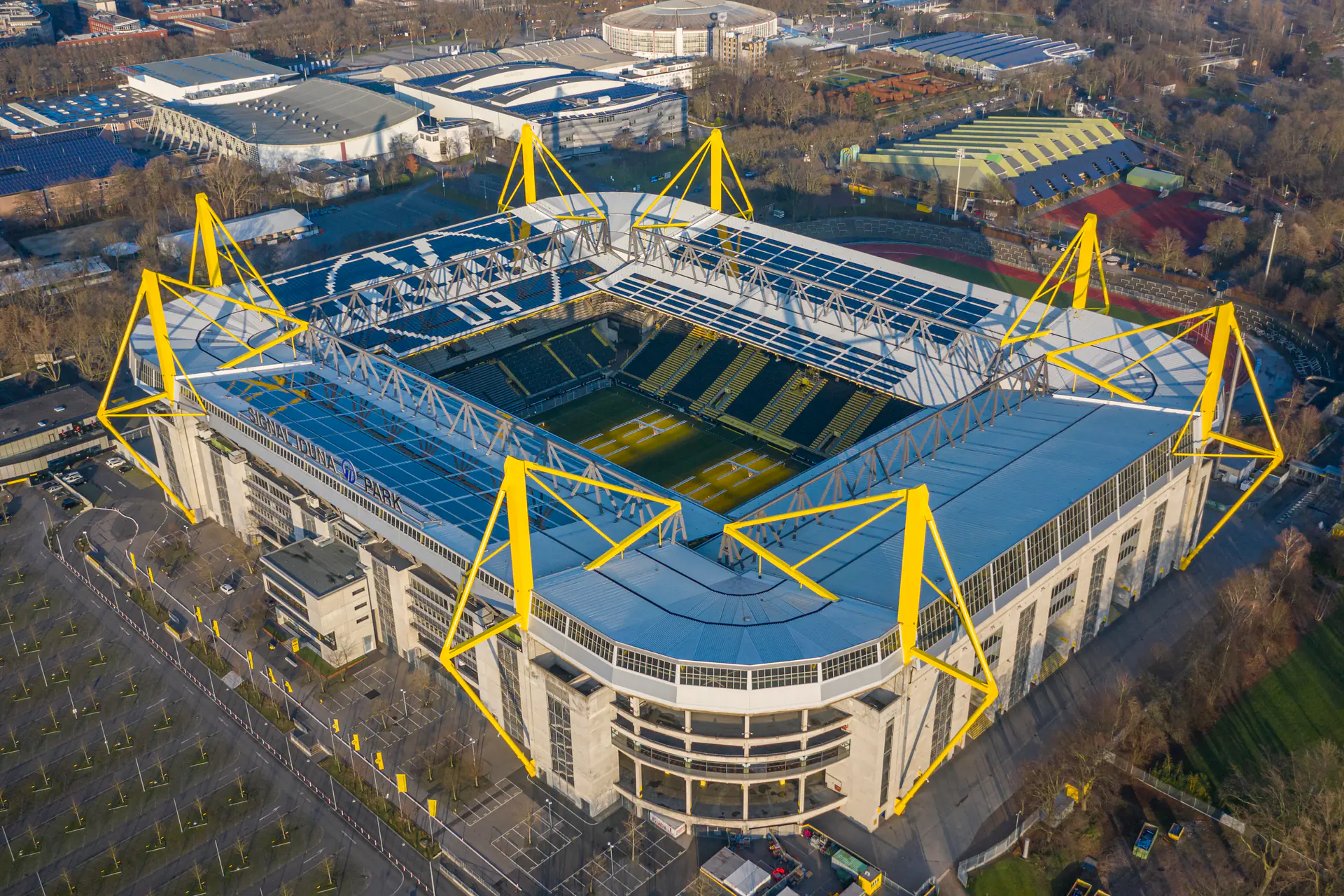
Signal Iduna Park — known historically and to most Borussia Dortmund supporters as the Westfalenstadion — is Germany's largest football stadium and one of the loudest, most atmospheric grounds in world football. Opened on 2 April 1974 for the FIFA World Cup hosted by West Germany, the ground has been the home of Borussia Dortmund (BVB) for over five decades. Bundesliga capacity sits at an enormous 81,365 thanks to extensive standing sections; UEFA matches (which require all-seated configurations) reduce it to around 65,800. The stadium is the centrepiece of Dortmund's Strobelallee sporting district, sitting alongside the Westfalenhalle arena and the Volksgarten park, about 2 km south-west of Dortmund Hauptbahnhof.
The stadium's defining feature is the Südtribüne — the 'Gelbe Wand' or Yellow Wall — a single-tier standing terrace holding 24,454 supporters, the largest free-standing grandstand in European football. The wall of yellow-and-black banners, coordinated tifos and unrelenting chants is widely regarded as the most spectacular matchday spectacle in club football. BVB have lifted eight Bundesliga titles including the Klopp-era doubles of 2010/11 and 2011/12, the 1997 UEFA Champions League trophy, and the DFB-Pokal five times. The Westfalenstadion has hosted matches at the 1974 and 2006 FIFA World Cups and the UEFA Euro 2024. Visiting on a matchday — particularly a Revierderby vs Schalke or a Klassiker vs Bayern Munich — is one of football tourism's essential pilgrimages.
Key Features
- ✓Germany's largest football stadium — Bundesliga capacity 81,365
- ✓The Südtribüne 'Yellow Wall' — 24,454 standing supporters in Europe's largest single-tier terrace
- ✓Home of Borussia Dortmund since 1974, with eight Bundesliga titles and the 1997 UEFA Champions League
- ✓Host venue for the 1974 FIFA World Cup, 2006 FIFA World Cup and UEFA Euro 2024
- ✓Named "Signal Iduna Park" since 2005 (sponsor) but universally known as the Westfalenstadion to BVB fans
History
The Westfalenstadion was built to host matches at the 1974 FIFA World Cup hosted by West Germany. Construction lasted just two years on the site of the old Stadion Rote Erde (which still stands next door as Borussia Dortmund's reserve and women's ground). The original stadium had a capacity of around 54,000 with rectangular stands and the then-novel decision to abandon the running track that defined most German stadiums of the era — a choice that became standard across the Bundesliga two decades later.
The Klopp Era and Yellow Wall
The Südtribüne in its current configuration dates from the 1995-1999 expansions, when the original two-tier south stand was converted into the single 24,454-capacity standing terrace that became the Yellow Wall. Successive expansions in 2002-2003 added the second tiers to the east, north and west stands, raising capacity to its current level. The Jürgen Klopp era (2008-2015) — back-to-back Bundesliga titles 2010/11 and 2011/12, the 2013 Champions League final and 'Heavy Metal Football' — turned the Yellow Wall into a global football icon. Borussia Dortmund is the only club in the world whose home stand has its own brand identity.
Naming Rights and Modern Era
In 2005, a long-term sponsorship deal with the Dortmund-based insurance group Signal Iduna renamed the stadium Signal Iduna Park. The deal has been renewed multiple times and runs through 2031, making it one of the most stable sponsorship arrangements in European football. BVB supporters continue to use the original Westfalenstadion name in everyday speech, and UEFA matches use the sponsorship-neutral name BVB Stadion Dortmund.
World Cup and Euros
The stadium has been a fixture of major tournaments: six matches at the 1974 World Cup, six at the 2006 World Cup (including the Germany v Italy semi-final), and six at UEFA Euro 2024 (including the England v Switzerland quarter-final). The 2006 tournament prompted upgrades to seating, hospitality and accessibility that brought the ground to current FIFA standards.
Tickets & Tours
How to Get Borussia Dortmund Tickets
There are three main ways to attend a BVB match at Signal Iduna Park:
1. Official Club Tickets (Best Value)
Buy directly from bvb.de — general sale typically opens 2-4 weeks before kickoff. Prices range from €16 (Südtribüne standing) to €110+ (Osttribüne premium). German rules require nominative tickets with a matching photo ID.
⚠️ Important: Klassiker vs Bayern Munich, Revierderby vs Schalke (when in same division), and Champions League knockouts sell out instantly. The BVB Member scheme prioritises members for these matches. Standing tickets (Südtribüne) are almost entirely held by season-ticket holders and are very difficult for international visitors to acquire through official channels.
2. Official Hospitality (Guaranteed Access)
BVB hospitality at Signal Iduna Park includes:
- Business Seats Westtribüne — central seats with lounge access, from €180
- Champions Club — premium hospitality with Westphalian regional cuisine, from €280
- Logen-Plätze — private boxes for 4-12 guests, from €350+ per person
Book via the BVB business desk through the official portal.
3. Third-Party Platforms (Sold-Out Matches)
For sold-out fixtures, established platforms aggregate verified resale:
- LiveFootballTickets — Bundesliga specialists, from €80
- SeatPick — comparison platform
⚠️ Note: German nominative-ticket rules mean some resale tickets cannot be legally transferred. Verify the seller can re-issue in your name. For Klassiker, prices on the secondary market often exceed €300 face value.
Signal Iduna Park Stadium Tour
BVB operates one of the Bundesliga's best stadium tours — particularly worth a visit for the Yellow Wall walk-out experience.
What You'll See
- Yellow Wall (Südtribüne) access — stand on the famous terrace and feel the scale
- BVB Dressing Room including the players' jersey hooks and tactics whiteboard
- Players' tunnel with the route onto the pitch
- Pitch-side and dugouts — sit in the BVB technical area
- Pressekonferenzraum (press room) where post-match interviews take place
- BVB Champions League trophy (1997) and Bundesliga title silverware
- History exhibition spanning 1909 founding, 1966 Cup Winners' Cup, 1997 UCL, Klopp era and modern eight Bundesliga titles
Practical Details
- Duration: Approximately 90 minutes
- Schedule: Daily except matchdays — typically multiple slots, 09:30 to 17:00
- Price: Adults around €18-25, children €10-15, family packages available
- Languages: German and English (English tours by advance request)
- Accessibility: Excellent — full wheelchair access throughout
Booking
- GetYourGuide
- Viator
- Direct: bvb.de
Pro tip: Combine the tour with the Deutsches Fußballmuseum (German Football Museum) opposite Dortmund Hauptbahnhof — Germany's national football museum opened 2015, one of Europe's best dedicated football museums.
Quick Tips
- Bring photo ID: Tickets are nominative under Bundesliga rules
- Yellow Wall access: Almost impossible for visitors — book Westtribüne for the best seated view of the Wall instead
- Klassiker: Bayern Munich visits are the toughest tickets in German football — plan months ahead
- UEFA nights: Atmosphere is muted vs Bundesliga; book Bundesliga for the full experience
- Train from Köln, Düsseldorf, Frankfurt: ICE direct trains in 1-2 hours, very practical for matchday trips
Best Seats at Signal Iduna Park
The stadium is configured as a four-stand rectangular bowl with the Südtribüne (Yellow Wall) at the south end, the Nordtribüne opposite, and the Osttribüne and Westtribüne on the long sides. Sightlines from anywhere are good thanks to the steep stands and the absence of a running track.
Südtribüne — Block 12, 13, 80, 81 (The Yellow Wall — Standing Only)
The Südtribüne is the most famous home end in world football. It's an all-standing terrace of 24,454 capacity in a single tier — Europe's largest standing section by far. The atmosphere is unmatched: relentless 90-minute singing, coordinated tifos for every major match, and the famous 'Heja BVB!' chant. Tickets are typically €16-25 for Bundesliga, available primarily to BVB members through a season-pass-priority system. International visitors can occasionally buy in the secondary market but face significant restrictions — German football's nominative-ticket and 50+1 rules apply strictly.
⚠️ UEFA matches: the Südtribüne is converted to seats for Champions League and Europa League fixtures, reducing capacity to ~13,000 in that stand and total ground capacity to ~65,800. The standing atmosphere is significantly muted.
Nordtribüne (Block 1-5, 60-67)
The north stand is a two-tier seated stand with strong views and a more international visitor mix. Lower tier seats (Blocks 1-5) sit close to the pitch and behind the goal; upper tier (60-67) offers panoramic views including the Yellow Wall opposite. Prices €35-60.
Osttribüne (East Long Side)
The east long side is the main hospitality and premium-seating area. Westfalenstadion VIP packages cluster here, plus the Signal Iduna Lounge corporate boxes. Standard seats run €50-95; central premium sections €100-180+.
Westtribüne (West Long Side)
The west long side houses the players' tunnel, dugouts and main press area. Tribune Westwall seats face the Yellow Wall directly — for visitors who want the view of the Yellow Wall in full, this is the seat to choose. Prices €45-90.
Premium & Hospitality
- Business Seats Westtribüne — central seats with hospitality lounge access from €180-300
- Logen-Plätze (Boxes) — private boxes for 4-12 guests, from €350+ per person
- Champions League / Klassiker upgrades — premium tiers double for Bayern Munich visits and Champions League knockouts
Accessibility
The Westfalenstadion has dedicated wheelchair-accessible platforms in all four stands, accessible toilets, lift access and a special 'Disabled Supporters' Section' with companion seating. Pre-booking required via BVB accessibility services.
Pro Tips
- Bucket-list seat: Westtribüne lower tier — view of the full Yellow Wall in choreography
- Affordable atmosphere: Nordtribüne upper, lower price than premium with good sightline
- For the Yellow Wall experience without standing: Westtribüne is the best seated equivalent
- Klassiker vs Bayern Munich: Demand is extreme — book the instant tickets release or accept resale at 200%+ face value
- Revierderby vs Schalke: Now a 2. Bundesliga fixture but historically the most intense German derby
- UEFA nights: Lower atmosphere than Bundesliga due to all-seated configuration — Bundesliga is the bucket-list visit
Match Day Experience
A matchday at Signal Iduna Park is widely considered the loudest, most coordinated supporter atmosphere in world football. The combination of 81,000+ in attendance, the unrelenting Yellow Wall, and the ritualised BVB pre-match traditions makes a Bundesliga matchday here essentially mandatory for any football tourist.
Pre-Match (2-3 hours before)
BVB matchdays gather in three main zones. Strobelallee (the road outside the stadium) becomes a yellow-and-black river of fans walking from the Westfalenhalle U-Bahn stop. The Borsigplatz in northern Dortmund — the historic 'birthplace' of BVB where the club was founded in 1909 — sees traditional pre-match gatherings before fans take the U-Bahn south. Dortmund Hauptbahnhof and the central old town fill with fans en route. Try Strobel's Imbiss (legendary bratwurst stand outside the ground), Hövels Hausbrauerei (Dortmund brewery in the old town), or Wenkers am Markt (central biergarten with pre-match Pils). The walk down Strobelallee is a sea of yellow scarves and Schal-Schwenken (scarf-waving).
Inside the Stadium
Gates open roughly 90 minutes before kickoff. The pre-match build-up is unique in German football. The famous 'Heja BVB!' roar from the Yellow Wall begins as soon as gates open. 'You'll Never Walk Alone' — the Anfield anthem also adopted by BVB — plays over the PA five minutes before kickoff, and 81,000 fans sing along; this is one of football's great chills-down-the-spine moments. The Yellow Wall's choreographed tifos before major matches involve thousands of supporters holding coordinated cards or scarves — the 'Echte Liebe' ('True Love') tifo on derby days is iconic.
Food & Drink
Concession kiosks sell traditional Dortmund matchday fare — bratwurst, currywurst, Pommes (chips) with mayo, plus the locally brewed Brinkhoff's No.1 (BVB's official beer) and Dortmunder Pils. Beer in plastic cups (Bundesliga grounds allow beer service); typically €4.50 for 0.4L. Hospitality lounges in the Osttribüne offer Westphalian regional menus.
After the Match
Post-match crowds funnel back along Strobelallee to the U-Bahn (Westfalenhallen/Stadion station). The central Dortmund nightlife in the old town and around Bornstraße picks up afterwards. Hövels Hausbrauerei and Brauerei Wenker are traditional choices; the Brückstraße area has many late-night bars. Note that Bundesliga afternoon kickoffs (15:30 Saturday) mean the post-match drinks last well into the evening.
International Visitor Tips: German tickets are nominative — bring matching photo ID. The Bundesliga is notably more affordable than the Premier League, with standing tickets from €16 and seats from €35. Combine a BVB matchday with a visit to the Deutsches Fußballmuseum (German Football Museum) opposite Dortmund Hauptbahnhof — one of football's best dedicated museums.
Bag Policy & Prohibited Items
German Bundesliga security. Bags larger than A4 are not permitted. Small handbags and rucksacks under 22cm × 17cm × 5cm are subject to search. Prohibited items: large backpacks, umbrellas with rigid handles, professional cameras with detachable lenses, selfie sticks, flares, glass and outside food/drink. Tickets are nominative under Bundesliga rules — bring matching photo ID. Arrive 60-90 minutes before kickoff; for Klassiker or Champions League fixtures, 2 hours.
Getting There
🚇 Metro
Take the Stadtbahn (U-Bahn) lines U42, U45 or U46 to 'Westfalenhallen / Stadion' — the dedicated stadium stop, a 5-minute walk to the ground. Trains run every 5-10 minutes on matchdays. From Dortmund Hauptbahnhof the U-Bahn journey is 8-10 minutes.
🚌 Bus
Multiple DSW21 bus lines serve the Westfalenhallen / Strobelallee area, including matchday-specific shuttle services. The Stadtbahn is faster and more frequent for most visitors.
🅿️ Parking
Very limited matchday parking — most stadium parking is for BVB season-ticket holders. The closest public options are Parkhaus Westfalenhallen (€5-8 matchday rate, fills early) and on-street parking around the Volksgarten (free but very limited). The recommended approach for visitors is to use the U-Bahn from a hotel near Dortmund Hauptbahnhof.
🚶 From City Center
The stadium is ~2 km south-west of Dortmund Hauptbahnhof — a 25-minute walk through the central city and Westfalenpark. From the Westfalenhallen U-Bahn stop, it's a 5-minute walk. A taxi from Hauptbahnhof costs around €10-12 matchday surge pricing.
Where to Stay for Signal Iduna Park
Near the Stadium (Westfalenhallen / Volksgarten)
Search hotels near Signal Iduna Park
The immediate stadium area is residential and conference-district. Most international visitors stay in the central old town near Dortmund Hauptbahnhof — the U-Bahn is fast and the matchday vibe builds en route.
Mercure Hotel Dortmund Centrum (1.5 km)
Mid-range chain near the stadium with comfortable rooms and on-site parking. Practical for match-focused trips.
Dortmund Centre / Old Town (Recommended)
Search hotels in central Dortmund
The central Innenstadt is walkable to the main pre-match bars (Hövels, Wenkers, Brauhaus) and offers a quick U-Bahn ride to the stadium.
Steigenberger Hotel Dortmund (Old Town, 2.5 km)
Four-star landmark on Berswordtstraße with classic Dortmund hospitality. Walking distance to the Christmas market square and Hövels brewery. Good restaurant.
Park Inn by Radisson Dortmund (2 km from stadium)
Reliable four-star opposite Dortmund Hauptbahnhof with city views. U-Bahn access to the stadium is immediate. Practical for one-night matchday visits.
Ruhr Valley Hub Options
Dortmund pairs naturally with the wider Ruhr region. Essen (30 min by ICE) and Düsseldorf (45 min by ICE) are alternative bases for visitors combining BVB with other Ruhr region football (Schalke, Bochum). Frankfurt is 90 minutes away by ICE.
Our Recommendation
For most visitors, stay in central Dortmund near the Hauptbahnhof for the matchday atmosphere, easy U-Bahn access and the old-town bars. The combination of BVB matchday + Deutsches Fußballmuseum + old-town brewery dinner is the canonical Dortmund weekend. For luxury, the Steigenberger is the obvious choice; for value, the Park Inn opposite the Hauptbahnhof is excellent.
Frequently Asked Questions
The stadium was renamed Signal Iduna Park in 2005 after a long-term naming rights deal with the Dortmund-based insurance group Signal Iduna. The deal has been renewed multiple times and runs through 2031. Borussia Dortmund supporters continue to use the original "Westfalenstadion" name in everyday speech, and UEFA matches use the sponsorship-neutral name "BVB Stadion Dortmund".
BVB tickets at Signal Iduna Park typically range from €16 (Südtribüne standing, very limited for non-members) to €110+ (Osttribüne premium). Klassiker vs Bayern Munich and Champions League knockouts are heavily oversubscribed and often only available via hospitality (from €180) or the secondary market. Stadium tours are €18-25.
Buy directly from bvb.de/eng/Tickets. German rules require nominative tickets matched to a photo ID, so the secondary market is risky unless the seller can legally re-issue in your name. BVB Member status unlocks earlier sales windows but is restricted by season-ticket-holder priority.
In practice, very rarely. The Südtribüne is almost entirely held by BVB season-ticket holders through a member-priority system. Some Bundesliga matches release Yellow Wall tickets on general sale, but these sell out instantly. International visitors are strongly advised to book the Westtribüne (lower tier) for the best seated view of the Yellow Wall instead, or to take the stadium tour, which includes a walk onto the Südtribüne itself.
Yes — BVB operates daily stadium tours (except matchdays) including access to the Yellow Wall, the BVB dressing room, the players' tunnel, dugouts, the 1997 Champions League trophy, and the BVB history exhibition. Adults €18-25, 90 minutes. Combine with the German Football Museum opposite Dortmund Hauptbahnhof.
Bags larger than A4 (21cm × 30cm) are not permitted. Small handbags and rucksacks under 22cm × 17cm × 5cm are allowed but subject to search. Prohibited items include large backpacks, umbrellas with rigid handles, professional cameras with detachable lenses, selfie sticks, flares, glass and outside food/drink. German rules require nominative tickets matched to a photo ID.
Bundesliga capacity at Signal Iduna Park is 81,365 thanks to the all-standing Südtribüne (24,454). UEFA matches require all-seated configurations, so the Südtribüne is converted to seats, reducing the stand to ~13,000 and total ground capacity to approximately 65,800. The standing atmosphere is significantly muted on UEFA nights — visit on a Bundesliga matchday for the full Yellow Wall experience.
Take the U-Bahn (Stadtbahn) lines U42, U45 or U46 from Dortmund Hauptbahnhof to 'Westfalenhallen / Stadion' — an 8-10 minute journey. The stadium is then a 5-minute walk. Trains run every 5-10 minutes on matchdays. Alternatively a 25-minute walk through the city and Westfalenpark.
Details on this page can change without much notice, and cup or European fixtures often run different rules. Last reviewed 8 August 2026 — worth confirming anything important with the club before you travel.
Related Stadiums
Other stadiums in Bundesliga
Tickets & Tours
Stadium Name History
Visit www.stadiumseeker.com for tickets, tours, and interactive maps