Hamburg, Germany
Overview
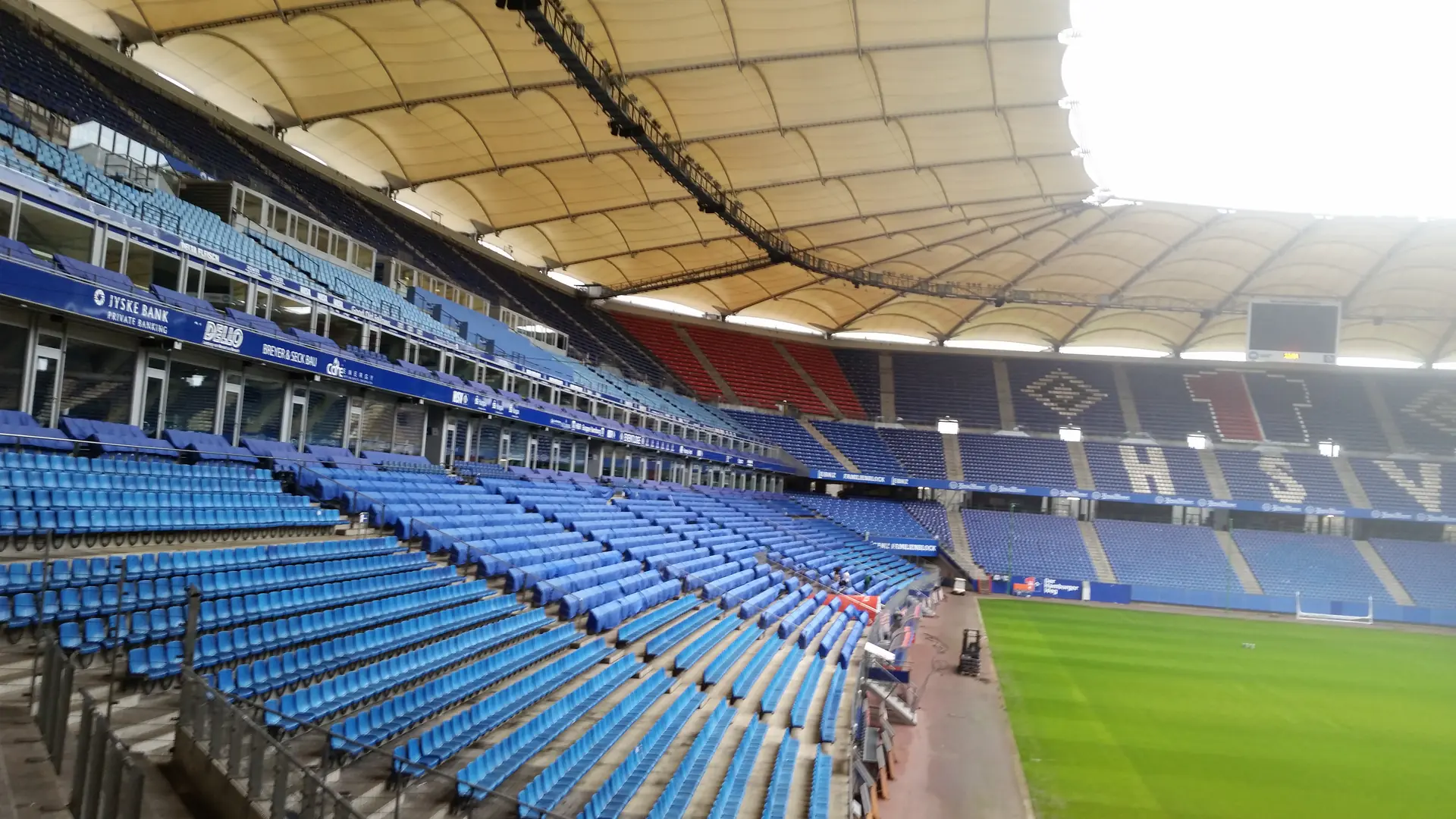
The Volksparkstadion is the home of Hamburger SV and one of the largest grounds in Germany, holding 57,000 for Bundesliga matches and 51,500 for internationals and European fixtures, when the standing terrace must be converted to seating. The breakdown tells you what kind of ground it is: 42,549 seats, 10,000 standing places, 3,620 business seats, 711 box seats and 120 wheelchair positions.
Opened in 1953 and rebuilt almost entirely between 1998 and 2000, it sits in the Altonaer Volkspark in the west of Hamburg, surrounded by woodland rather than housing. HSV carry a particular weight in German football: they were the only club ever-present in the Bundesliga from its 1963 founding until relegation in 2018, and the stadium clock that counted their unbroken run became one of the sport's better-known symbols. The ground hosted matches at UEFA Euro 2024, and pairs naturally with a trip to Signal Iduna Park or the Allianz Arena.
Key Features
- ✓Capacity 57,000 — 42,549 seats plus a 10,000-strong standing terrace
- ✓The Nordtribüne — where HSV's ultras groups have their sections
- ✓Rebuilt 1998-2000 within the Altonaer Volkspark, surrounded by woodland
- ✓Free travel across the whole Hamburg network with a match ticket
- ✓A UEFA Euro 2024 host venue
History
The Volksparkstadion opened in 1953 on the site of a pre-war arena in Hamburg's Altonaer Volkspark, a large municipal parkland west of the city. In its original form it was a classic oval with a running track and an open bowl, holding crowds well beyond what its facilities could comfortably serve.
The great years
Hamburger SV's peak came around the turn of the 1980s: three Bundesliga titles, the 1977 European Cup Winners' Cup, and the 1983 European Cup, won against Juventus in Athens under Ernst Happel. Kevin Keegan spent three seasons at the club in that era and was twice named European Footballer of the Year while there.
The rebuild
Between 1998 and 2000 the ground was almost entirely reconstructed — the running track removed, the stands brought close to the pitch, and a modern roofed bowl built while HSV continued to play. It hosted matches at the 2006 World Cup and at UEFA Euro 2024.
The clock, and the fall
HSV were the only club present in every Bundesliga season from the league's founding in 1963, a run marked inside the stadium by a clock counting the years, days and minutes since it began. In 2018 the run ended in relegation, and the clock was reset to count time in the second division instead — a piece of theatre that made national news. The club spent several seasons in the 2. Bundesliga before returning to the top flight.
Tickets & Tours
How to Get Hamburger SV Tickets
HSV have one of the largest and most loyal season-ticket bases in Germany, which makes general availability tighter than the 57,000 capacity suggests.
1. Official Club Tickets
Buy from hsv.de. Tickets are released after member pre-sales, typically a few weeks before each match. Prices are low by European standards: Nordtribüne standing is among the cheapest football in the country, and seated tickets generally range from around €30 to €75 depending on tier and opponent.
⚠️ Important: The Nordderby against Werder Bremen, and visits from Bayern and Dortmund, sell out well in advance. HSV's support remained strong throughout their years outside the top flight, so do not assume tickets will be easy simply because a fixture looks unremarkable.
2. Official Hospitality
With 3,620 business seats and 711 box seats, the Volksparkstadion has a deep hospitality inventory. Packages include catering and lounge access and are frequently available when ordinary tickets are gone — a more realistic route in here than at many German grounds.
3. Third-Party Platforms
Resale sites list HSV fixtures and we deliberately do not link to them. German clubs including HSV operate personalised ticketing on selected matches and do refuse entry when names do not match, and resale prices bear no relation to the low face values. Official channels and hospitality are both better options.
Stadium Tours
HSV run guided tours of the Volksparkstadion, taking in the areas closed on matchdays and the club's history.
What You'll See
- Dressing rooms and the players' tunnel
- Pitchside and the dugouts
- The press conference room
- Business and box areas
- The Nordtribüne from ground level, and the story of the Bundesliga clock
Practical Details
- Duration: approximately 60-90 minutes
- Schedule: regular dates outside matchdays and events, published on the club website
- Booking: in advance through HSV — dates are limited around the fixture list
- Languages: German, with English available on selected dates
- Accessibility: step-free throughout
Booking
- GetYourGuide — tour availability
- Viator — experiences in Hamburg
Pro tip: Ask about the stadium clock. Its reset after the 2018 relegation is the single best-known piece of HSV iconography and the tour covers it properly.
Quick Tips
- Your ticket is your travel pass across the entire Hamburg network
- Nordtribüne standing is the cheapest and the loudest
- Hospitality is deep here — a realistic fallback for sold-out matches
- Combine with St. Pauli for two very different Hamburg matchdays
Best Seats at the Volksparkstadion
A modern, fully roofed bowl with good sightlines throughout — the rebuild removed the running track, so nothing sits far from the pitch.
Nordtribüne (North Stand)
HSV's home end and where the ultras groups have their sections. This is the standing terrace for Bundesliga matches, roughly 10,000 places, converted to seating for European and international fixtures. It is the cheapest and by far the most atmospheric part of the ground. Away supporters should not buy here.
Südtribüne (South Stand)
Opposite the Nordtribüne, and where the away allocation sits. Views behind the goal are good, and the atmosphere depends on the visiting support.
Lower Tier and Upper Tier sidelines
The Lower Tier along the east and west sides puts you closest to play, with central blocks priced highest and corners offering better value. The Upper Tier is higher and further back, giving the best view of the shape of the game and full cover from the roof — worth considering given Hamburg's weather.
VIP & Hospitality
The ground has 3,620 business seats and 711 box seats, concentrated on the west side with lounge access and catering. That is a large hospitality inventory by German standards, and it means packages are often available when general tickets are not.
Accessibility
The stadium provides 120 wheelchair positions with companion seating — among the higher provisions in the Bundesliga — and the rebuilt concourses are step-free with lifts to the upper tier. Book accessible places directly with the club.
Pro Tips
- Best atmosphere: Nordtribüne standing
- Best value: Upper Tier corners
- Best view: Upper Tier, halfway line
- Best in bad weather: anywhere in the Upper Tier, fully covered
Match Day Experience
Hamburg is one of the better away days in Germany — a genuinely enjoyable city, an easy S-Bahn ride to the ground, and a stadium set in parkland rather than a car park.
Getting In
Gates open around two hours before kickoff. The walk from Stellingen station through the Volkspark takes ten to fifteen minutes and is pleasant in a way few stadium approaches are, running through woodland with the crowd building as you go.
Before the Match
Mobile food stands and small bars set up around Stellingen S-Bahn station and along the approach, serving sausages, snacks and beer to the crowd in both directions. There is no pub district at the ground itself, so most supporters drink in the city first — the Schanzenviertel and St. Pauli areas are the usual choices, both lively and well connected.
Food & Drink
Inside, the offering is standard German stadium fare done at scale: bratwurst, currywurst, pretzels and beer in reusable cups against a refundable deposit. Prices are moderate, and the rebuilt concourses are wide enough that half-time queues move. Card payment is accepted throughout.
Inside the Stadium
The Nordtribüne drives the noise, with the ultras groups leading chants and mounting displays before kickoff. The full roof holds sound in well. HSV's support is famously loyal — attendances stayed high throughout the years in the second division — so even mid-table fixtures draw large, committed crowds.
After the Match
The S-Bahn at Stellingen absorbs the crowd steadily, and your match ticket covers the journey across the entire Hamburg network. Trains run late, and the city centre, the Reeperbahn and the harbour are all straightforward to reach afterwards.
International Visitor Tips: Hamburg is worth a weekend on its own — the harbour, the Elbphilharmonie, the Speicherstadt warehouse district — and the football fits around it easily. If you can, combine an HSV fixture with a match at St. Pauli's Millerntor across the city for a study in contrasts.
Bag Policy & Prohibited Items
⚠️ Important: HSV apply the standard German stadium rule — bags larger than A4 size are not permitted inside the Volksparkstadion.
Currently allowed:
- Small bags and handbags within A4 dimensions
- Phones and compact cameras
- Soft flags and banners without poles
- Essential medication
Prohibited:
- Backpacks, rucksacks and larger bags
- Bottles, cans and outside drinks
- Flares, fireworks and pyrotechnics
- Umbrellas with pointed tips
- Professional camera equipment
Storage: There is no substantial left-luggage facility at the ground, which sits in parkland with nothing but woodland around it. Hamburg Hauptbahnhof and Altona station both have extensive lockers, and both are on the S-Bahn line you will be using — leave anything oversized there before travelling out.
Security: Searches are carried out at the turnstiles and are thorough, with the Nordtribüne entrances busiest. Allow 30-45 minutes between arriving at Stellingen and being in position, and longer if you want a specific spot on the terrace. Rules differ for European fixtures and concerts, so check the club's official matchday information before travelling.
Getting There
🚇 Metro
The S-Bahn is the way in. S3 and S21 services run to Stellingen, from where it is a 10-15 minute walk through the Volkspark to the ground. From Hamburg Hauptbahnhof the journey takes around 15 minutes, and from Altona it is shorter still. Services are heavily reinforced on matchdays. Crucially, an HSV match ticket includes free travel across the entire Hamburg transport network in both directions, so no separate fare is needed.
🚌 Bus
Local bus routes serve the Volkspark area and can be useful coming from parts of west Hamburg that the S-Bahn does not cover directly, but for almost everyone the S-Bahn to Stellingen is faster and better organised on a matchday. Buses are also covered by the match ticket.
🅿️ Parking
There is parking around the Volkspark complex, but it is limited relative to a 57,000 crowd, fills early and empties slowly through parkland roads. By road, the ground is reached from the A7 motorway on the western side of Hamburg. Given that public transport is free with your ticket, frequent and quick, driving is difficult to justify unless you are staying nearby.
🚶 From City Center
From Stellingen S-Bahn station it is a 10-15 minute walk through the Altonaer Volkspark — a genuinely pleasant approach through woodland and open parkland, well signed and busy with supporters on matchdays. The ground is around 8 km west of Hamburg city centre, so walking the whole way from town is not realistic.
Where to Stay for the Volksparkstadion
Near the Stadium
Search hotels near the Volksparkstadion
The ground sits inside a large public park with woodland on most sides and very little accommodation nearby. A few hotels serve the Bahrenfeld and Stellingen areas, convenient for an early kickoff but quiet in the evening and some way from anything else.
Hamburg City Centre (Recommended)
Search hotels in Hamburg city centre
The sensible base. The Hauptbahnhof area puts you about 15 minutes from Stellingen by S-Bahn, free with your match ticket, and within reach of the Rathaus, the Alster lakes and the Speicherstadt. It is also the best-connected point for onward travel.
St. Pauli and the Schanzenviertel
Search hotels in St. Pauli
Where most visiting supporters end up in the evening. St. Pauli brings the Reeperbahn and the harbour; the neighbouring Schanzenviertel is less raucous and stronger for food and bars. Both sit on good S-Bahn connections to Stellingen, and both put you near the Millerntor if you want a second match.
Our Recommendation
Stay in the Schanzenviertel or St. Pauli if the evening matters, and near the Hauptbahnhof if connections do. Either way you are a short, free S-Bahn ride from the ground, and Hamburg is a city worth building a weekend around rather than just passing through.
Book early for the Nordderby against Werder Bremen and for the summer months, when Hamburg is a popular destination in its own right and hotel prices climb.
Frequently Asked Questions
The Volksparkstadion holds 57,000 for Bundesliga matches — 42,549 seats, 10,000 standing places, 3,620 business seats, 711 box seats and 120 wheelchair positions. For international and European fixtures the standing terrace is converted to seating, reducing capacity to 51,500.
Take the S3 or S21 S-Bahn to Stellingen — about 15 minutes from Hamburg Hauptbahnhof — then walk 10 to 15 minutes through the Volkspark. Your match ticket includes free travel across the whole Hamburg network.
Bags larger than A4 size are not permitted. The ground is in parkland with no significant left-luggage facility, so use the lockers at Hamburg Hauptbahnhof or Altona, both on the S-Bahn line you will be taking.
HSV were the only club present in every Bundesliga season from the league's founding in 1963, and a clock inside the stadium counted the years, days and minutes of that run. When HSV were relegated in 2018 the clock was reset to count their time in the second division instead.
The away allocation is in the Südtribüne, at the opposite end from the Nordtribüne. Away supporters should not buy tickets for the Nordtribüne, which is where HSV's ultras groups have their sections.
Less easy than the 57,000 capacity suggests — HSV have one of the largest season-ticket bases in Germany and support stayed strong even in the second division. The Nordderby against Werder Bremen and visits from Bayern and Dortmund sell out well ahead.
Yes. Guided tours cover the dressing rooms, tunnel, dugouts, press room and business areas, along with the club's history and the story of the Bundesliga clock. Dates are published on the HSV website and are limited around the fixture list.
The Schanzenviertel or St. Pauli if you want a good evening, or near the Hauptbahnhof if connections matter more. All are a short S-Bahn ride from Stellingen and free with your match ticket.
Details on this page can change without much notice, and cup or European fixtures often run different rules. Last reviewed 8 August 2026 — worth confirming anything important with the club before you travel.
Related Stadiums
Other stadiums in Bundesliga
Tickets & Tours
Stadium Name History
Visit www.stadiumseeker.com for tickets, tours, and interactive maps