Leipzig, Germany
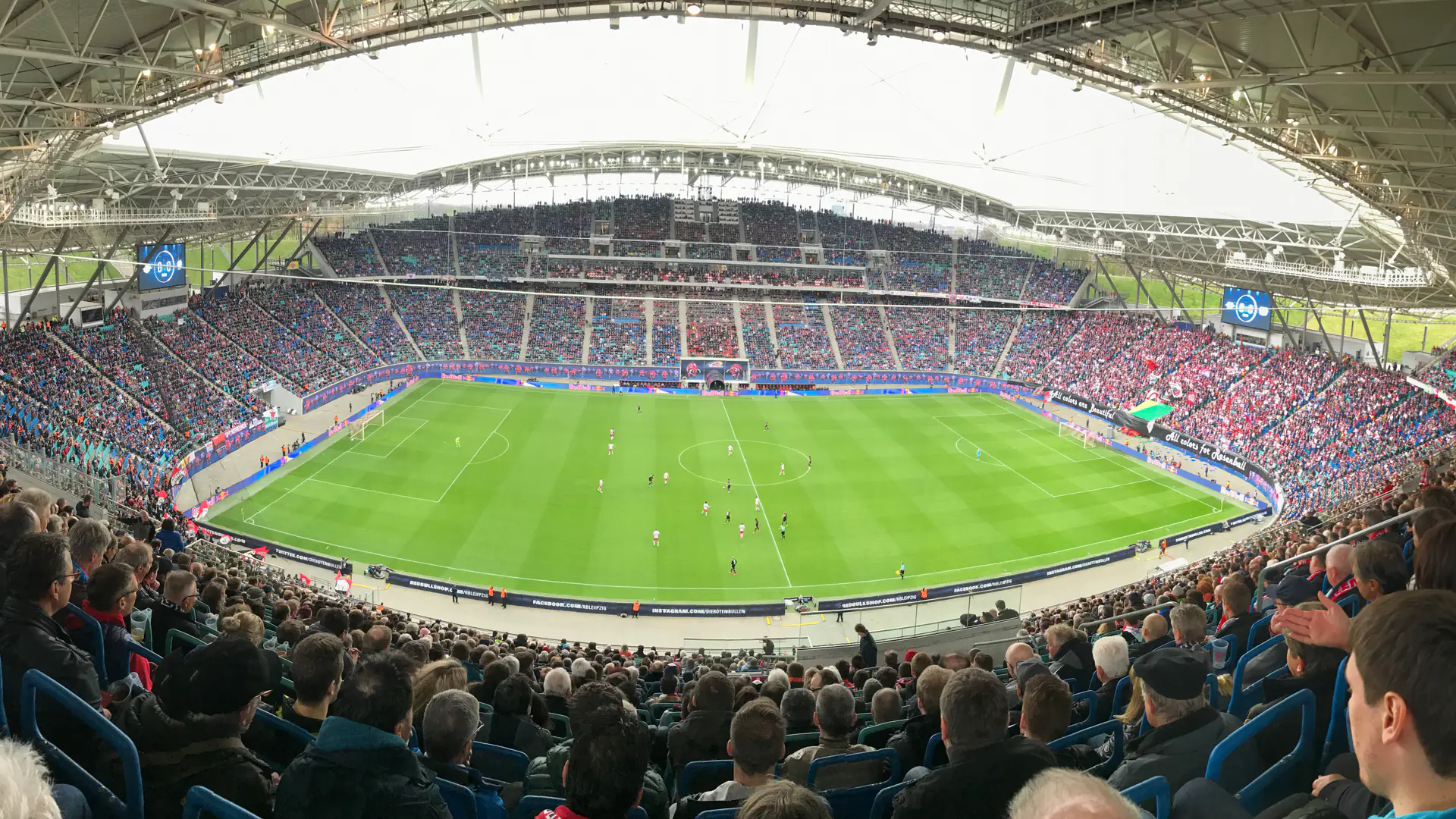
Overview
The Red Bull Arena is the home of RB Leipzig and one of the more unusual stadiums in Europe: a modern bowl built inside the earth embankment of its own predecessor. The original Zentralstadion was a vast 100,000-capacity earthwork raised from wartime rubble in the 1950s; when Leipzig needed a World Cup venue, the new ground was constructed within the old ring, which still surrounds it. You cross it on bridges to reach the turnstiles.
League capacity is 47,800, dropping to 45,228 for international fixtures. The roof was designed specifically to hold sound in, with the floodlights integrated into it, and a full house is loud. The ground sits just west of the city centre — close enough to walk in twenty-five minutes, or seven by tram. Along with Signal Iduna Park, it is one of the more straightforward German grounds to visit on a city break.
Key Features
- ✓Built inside the earth embankment of the old 100,000-capacity Zentralstadion
- ✓League capacity 47,800, reduced to 45,228 for international matches
- ✓Roof engineered for acoustics, with floodlights integrated into the structure
- ✓Seven minutes by tram from Leipzig Hauptbahnhof, or a 25-minute walk
- ✓Hosted four group matches and a last-16 tie at the 2006 World Cup
History
The Zentralstadion opened in 1956 as the largest stadium in Germany, an earth bowl for around 100,000 spectators built from the rubble of wartime Leipzig. It staged mass gymnastics displays and cup finals in the GDR era, but by the 1990s it was decaying and largely unused.
A stadium inside a stadium
Rather than demolish the embankment, the redevelopment between 2000 and 2004 placed an entirely new 45,000-seat bowl inside it. The old earth ring survives as the outer boundary, and spectators cross bridges over the gap to reach the modern structure — an arrangement that gives the approach an unusual sense of passing through one stadium into another.
The World Cup, and an empty ground
The rebuilt stadium hosted four group matches and a round-of-16 tie at the 2006 World Cup, but Leipzig had no top-flight club to fill it afterwards. Attendances collapsed and the venue became a well-known example of post-tournament overcapacity.
RB Leipzig
In 2009 the Red Bull group acquired the playing licence of fifth-tier SSV Markranstädt and founded RB Leipzig, which moved into the stadium in 2010 and renamed it the Red Bull Arena. Successive promotions took the club to the Bundesliga by 2016, and it has since become a Champions League regular and a DFB-Pokal winner. The project remains contested: many German supporters regard its corporate ownership structure as a circumvention of the 50+1 rule, and away ends here are often pointed about it.
Tickets & Tours
How to Get RB Leipzig Tickets
Leipzig are more obtainable than Bayern or Dortmund, but Champions League participation has tightened availability considerably.
1. Official Club Tickets
Buy from rbleipzig.com. Tickets are released after member pre-sales, generally a few weeks ahead. Prices remain low by European standards: standing places in Sektor B are among the cheapest in elite football, and seated tickets typically range from around €30 to €70 depending on tier and opponent.
⚠️ Important: Bayern, Dortmund and Union Berlin fixtures, and Champions League nights, sell out well in advance. Ordinary league matches are usually available closer to the date.
2. Official Hospitality
Business seats and lounge packages on the west side are bookable through the club and include catering. They are the reliable option for a sold-out fixture.
3. Third-Party Platforms
Resale sites list Leipzig matches and we deliberately do not link to them. German clubs including RB Leipzig operate personalised ticketing on selected fixtures and do refuse entry where names do not match, and resale prices bear no relation to the low face values. With official tickets usually obtainable, resale is rarely worth the risk here.
Stadium Tours
RB Leipzig run guided tours of the Red Bull Arena covering areas closed on matchdays.
What You'll See
- Dressing rooms and the players' tunnel
- Pitchside and the dugouts
- The press conference room
- VIP and business areas
- The view across the bowl, and the old Zentralstadion embankment from inside
Practical Details
- Duration: approximately 60-90 minutes
- Schedule: regular dates outside matchdays and event days, published on the club website
- Booking: in advance through the club
- Languages: German, with English available on selected dates
- Accessibility: step-free throughout
Booking
- GetYourGuide — tour availability
- Viator — experiences in Leipzig
Pro tip: The tour is one of the few chances to see the relationship between the modern bowl and the 1950s embankment properly, which is the genuinely unusual thing about this ground.
Quick Tips
- Walkable from the centre — 25 minutes, or 7 by tram
- Sektor B standing is the cheapest and best atmosphere
- Champions League nights sell out early
- Leipzig Hauptbahnhof has the lockers the stadium does not
Best Seats at the Red Bull Arena
A continuous two-tier bowl with no obstructed views and a roof that keeps noise inside. Pick on atmosphere and budget.
Sektor B (home end)
RB Leipzig's most vocal support sits behind the goal, with standing places for Bundesliga matches converted to seating for UEFA fixtures. This is where the drums, chants and flag displays come from, and it is the cheapest part of the ground.
Lower Tier sidelines
The Lower Tier runs continuously around the pitch and puts you close to the action. Central blocks are the most expensive; the corners offer much the same view for less. A good choice if proximity matters more than perspective.
Upper Tier
The Upper Tier is steeper and set further back, giving the clearest tactical view of the whole pitch and, because the roof overhangs it, some of the best shelter in poor weather. Usually the best value seated ticket.
Away section
Visiting supporters are allocated a section at the opposite end from Sektor B, with separate access. Given the club's polarising status, away ends here are frequently full and vocal.
VIP & Hospitality
Business seats, lounges and boxes occupy the west side at middle height, with catering included. These are usually obtainable when general tickets are not, and are booked through the club.
Accessibility
Wheelchair positions with companion seating are distributed around the lower tier, and the 2004 construction is step-free with lifts serving the upper tier. Book accessible places directly with the club.
Pro Tips
- Best atmosphere: Sektor B standing
- Best value: Upper Tier corners
- Best view: Upper Tier, halfway line
- Best shelter: Upper Tier, under the roof overhang
Match Day Experience
Leipzig is one of the easiest German matchdays for a visitor: the ground is close to the centre, the transport is simple, and the city is compact enough that everything is walkable.
Getting In
Gates open around two hours before kickoff. The approach across the old embankment and over the bridges is the distinctive part — allow a few minutes for it, and for the security checks at the outer ring.
Before the Match
There is a fan zone and food stalls on the approach, but the better option is the city. Leipzig's centre is twenty-five minutes' walk away and full of bars and restaurants, and the Waldstraßenviertel between the centre and the ground is a pleasant quarter to stop in on the way.
Food & Drink
Concourse catering is the German standard — bratwurst, currywurst, pretzels and beer in reusable cups against a deposit — at low prices and with quick-moving queues. Card payment is accepted throughout. The upper concourses are noticeably less crowded at half time than the lower ones.
Inside the Stadium
The roof was designed to retain sound and it works: a full Red Bull Arena is louder than its size suggests. Sektor B leads the singing. Atmosphere varies more than at older clubs — European nights and matches against Bayern, Dortmund and Union Berlin are considerably more charged than a routine league fixture, partly because visiting supporters make a point of it.
After the Match
Trams from Sportforum back to the Hauptbahnhof are frequent and absorb the crowd quickly. Walking back into the centre takes about twenty-five minutes and is well lit and busy, which many visitors prefer to queuing.
International Visitor Tips: Leipzig is an excellent short-break city in its own right — Bach's Thomaskirche, the Museum of Fine Arts, and a strong bar and music scene — and the stadium's proximity to the centre makes it one of the least logistically demanding trips in the Bundesliga.
Bag Policy & Prohibited Items
⚠️ Important: RB Leipzig apply the standard German rule — bags larger than A4 size are not permitted inside the Red Bull Arena.
Currently allowed:
- Small bags and handbags within A4 dimensions
- Phones and compact cameras
- Soft flags and banners without poles
- Essential medication
Prohibited:
- Backpacks, rucksacks and larger bags
- Bottles, cans and outside drinks
- Flares, fireworks and pyrotechnics
- Umbrellas with pointed tips
- Professional camera equipment
Storage: There is no large left-luggage facility at the stadium. Leipzig Hauptbahnhof is one of the biggest railway stations in Europe and has extensive lockers, and it is only seven minutes away by tram — use it before heading to the ground rather than arriving with a bag you cannot take in.
Security: Checks begin at the outer embankment ring, so there are effectively two stages between arriving and reaching your seat. Allow 30-45 minutes on a full-house matchday. Rules differ for European fixtures and concerts, so confirm on the club's official matchday page before travelling.
Getting There
🚇 Metro
Leipzig's tram network is the quickest way in. Lines 3, 7 and 15 run from Leipzig Hauptbahnhof to the Sportforum stop in about seven minutes, and services are heavily reinforced on matchdays. The Hauptbahnhof itself is a major hub with fast connections from Berlin, Dresden, Frankfurt and Munich, which makes the Red Bull Arena one of the easiest German grounds to reach from elsewhere in the country. The S-Bahn also serves the city centre from Leipzig/Halle Airport in around 15 minutes.
🚌 Bus
Local bus services run in the Sportforum area, but the trams are faster, more frequent and better signposted on matchdays, and almost all supporters use them. Buses are worth considering only if you are coming from a part of the city the tram lines do not serve directly.
🅿️ Parking
There is parking around the Sportforum complex, but capacity is limited relative to a 47,800 crowd and the exit is slow. By road, take exit 17 Leipzig-West from the A9 motorway, which runs west of the city. Given that the ground is a seven-minute tram ride or a twenty-five-minute walk from the main station, driving offers very little advantage here.
🚶 From City Center
The Red Bull Arena is about 2 km west of Leipzig city centre and the Hauptbahnhof — a 20 to 30 minute walk, flat and straightforward, much of it through the pleasant Waldstraßenviertel. Plenty of supporters walk in both directions, and after the final whistle it is often quicker than waiting for a tram. The final approach crosses the old Zentralstadion embankment on bridges.
Where to Stay for the Red Bull Arena
Near the Stadium
Search hotels near the Red Bull Arena
The Sportforum sits in a green sports complex with little accommodation immediately around it. The Waldstraßenviertel just east of the ground is a handsome residential quarter with some guesthouses and small hotels, and it is an easy walk to the turnstiles.
Leipzig City Centre (Recommended)
Search hotels in Leipzig city centre
The obvious choice. The centre is compact, walkable and only 2 km from the ground, with trams every few minutes and a 25-minute walk as a genuine alternative. You are also among the city's attractions — the Thomaskirche, the Museum of Fine Arts, the Nikolaikirche — and its bars and restaurants.
Near Leipzig Hauptbahnhof
Search hotels near Leipzig Hauptbahnhof
Practical if you are arriving by train or making Leipzig one stop on a wider trip. The station is the tram hub for the stadium and has extensive lockers, which matters given the A4 bag rule.
Our Recommendation
Stay in the city centre. Leipzig is one of the more rewarding cities in eastern Germany and the stadium is close enough that transport is a non-issue — this is a rare ground where you can walk back into town after the match and be eating within half an hour.
Book further ahead for Champions League nights and for the Leipzig Book Fair in March, when the city fills up.
Frequently Asked Questions
The Red Bull Arena holds 47,800 for Bundesliga matches, falling to 45,228 for international fixtures where standing areas must be converted to seating.
Take tram 3, 7 or 15 from Leipzig Hauptbahnhof to the Sportforum stop — about seven minutes. Alternatively it is a flat 20 to 30 minute walk west through the Waldstraßenviertel, which many supporters prefer after the match.
Bags larger than A4 size are not permitted. There is no significant left-luggage at the ground, but Leipzig Hauptbahnhof has extensive lockers and is seven minutes away by tram.
The original Zentralstadion was a 100,000-capacity earth bowl built from wartime rubble in the 1950s. Rather than demolish the embankment, the 2000-2004 redevelopment placed a new stadium inside it. The old earth ring still forms the outer boundary, and spectators cross bridges to reach the modern structure.
The club was created in 2009 when the Red Bull group acquired the playing licence of fifth-tier SSV Markranstädt. Many German supporters regard its ownership structure as a circumvention of the 50+1 rule that keeps clubs member-controlled, and away supporters here are often vocal about it.
Yes. Guided tours cover the dressing rooms, tunnel, dugouts, press room and VIP areas, and are the best way to see how the modern bowl sits inside the 1950s embankment. Dates are published on the club website.
More obtainable than at Bayern or Dortmund, though Champions League participation has tightened things. Ordinary league fixtures are usually available; matches against Bayern, Dortmund and Union Berlin, and European nights, sell out well ahead.
Leipzig city centre — it is compact, walkable, only 2 km from the ground and full of bars and restaurants. This is one of the few Bundesliga grounds where walking back into town after the match is genuinely the easy option.
Details on this page can change without much notice, and cup or European fixtures often run different rules. Last reviewed 8 August 2026 — worth confirming anything important with the club before you travel.
Related Stadiums
Other stadiums in Bundesliga
Tickets & Tours
Stadium Name History
Visit www.stadiumseeker.com for tickets, tours, and interactive maps