Mönchengladbach, Germany
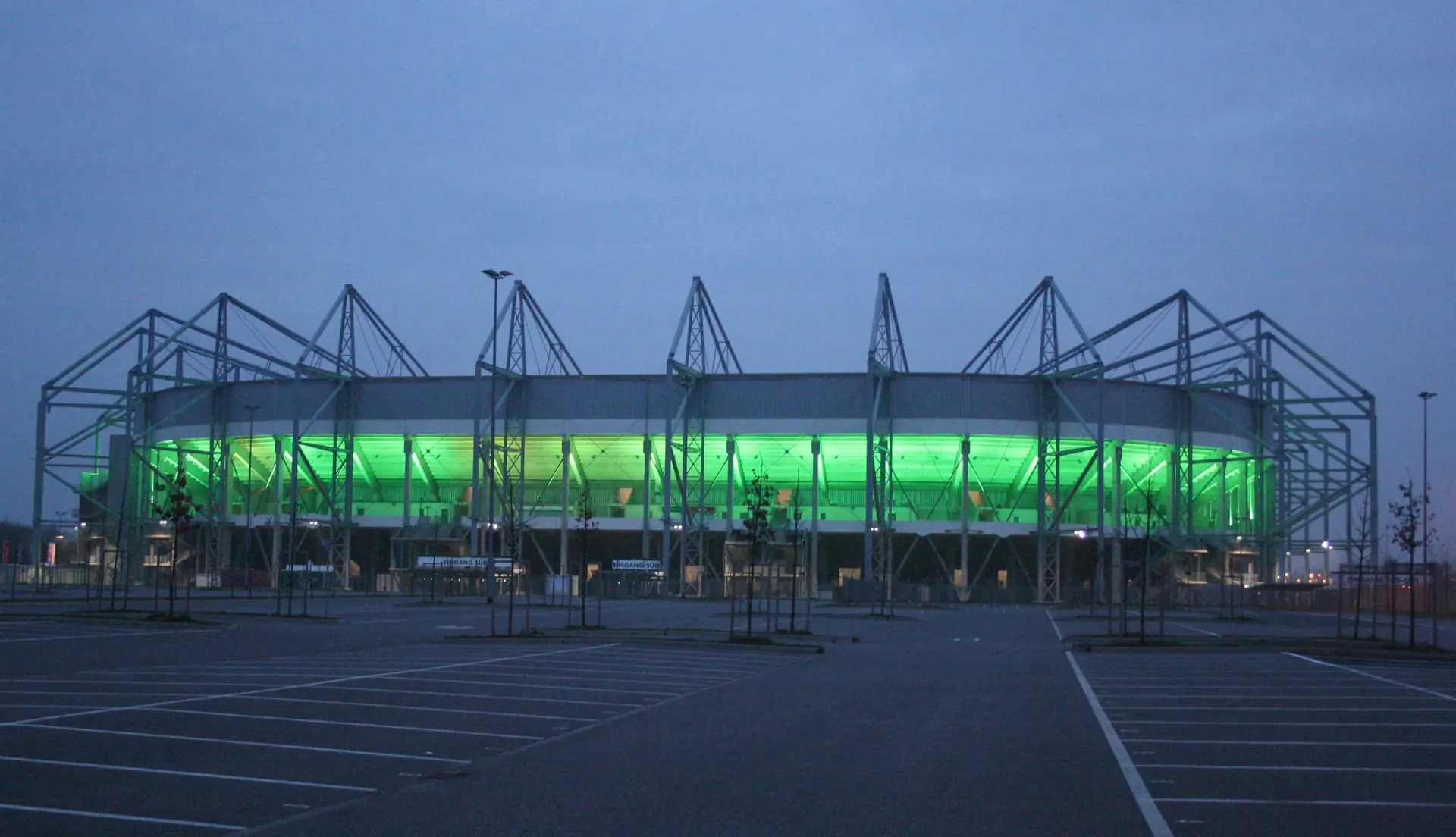
Borussia-Park
Mönchengladbach, Germany
Overview
Borussia-Park is the home of Borussia Mönchengladbach and one of the loudest grounds in Germany relative to its size, thanks to a Nordkurve whose lower tier packs in more than 16,000 standing supporters behind one goal. League capacity is 54,057, rising to a maximum of 60,250 when the south lower tier is also converted to standing, and falling to 46,311 for UEFA matches where everything must be seated.
Opened in 2004, it replaced the cramped and much-loved Bökelbergstadion, where Gladbach built their reputation in the 1970s as the most thrilling side in German football. The new ground sits on the edge of town rather than in it, surrounded by open land and its own training complex, and the club has worked hard to carry the old atmosphere across. It is an easy addition to a Rhineland football trip alongside the BayArena and Signal Iduna Park.
Key Features
- ✓The Nordkurve — over 16,000 standing supporters in a single lower tier
- ✓League capacity 54,057, up to 60,250 with the south terrace converted
- ✓Opened 2004, replacing the historic Bökelbergstadion
- ✓Free regional transport with a match ticket, plus a five-minute shuttle from the station
- ✓One of the cheapest stadium tours in the Bundesliga
History
Borussia Mönchengladbach spent eight decades at the Bökelbergstadion, a steep, tight ground in a residential quarter that became one of the most atmospheric in Germany — and, eventually, one of the most impractical, capped at around 34,500 with limited access and no room to grow.
Die Fohlen
Gladbach's golden era came in the 1970s under Hennes Weisweiler, when a young side nicknamed die Fohlen — the Foals — won five Bundesliga titles and the UEFA Cup twice, playing football widely regarded as the most attacking in Europe at the time. Names such as Günter Netzer, Berti Vogts, Jupp Heynckes and Allan Simonsen belong to that period, and the club's identity still rests heavily on it.
Building Borussia-Park
By the 1990s the Bökelberg could not support a modern budget. Construction of a replacement began in 2002 on open land at Nordpark on the edge of the town, and Borussia-Park opened in 2004 with a capacity above 54,000 — a large ground for a club of Gladbach's size, and a deliberate bet on the strength of its support. That bet has largely paid off: attendances have consistently ranked among the highest in the league.
Since the move
The club has oscillated between European qualification and relegation battles in the years since, but the Nordkurve's reputation has only grown. The complex also houses the club's training ground and academy, making it the single centre of Borussia's operations.
Tickets & Tours
How to Get Borussia Mönchengladbach Tickets
Gladbach are among the more obtainable big-crowd clubs in Germany, helped by a large ground and a mostly local season-ticket base.
1. Official Club Tickets
Buy from borussia.de. Tickets go on general sale after member pre-sales, usually a few weeks before each match. Prices are low: Nordkurve standing is among the cheapest terrace football in Europe, and seated tickets typically run from around €30 to €65 depending on tier and opponent.
⚠️ Important: The derby against Cologne, plus visits from Bayern and Dortmund, sell out quickly. Mid-table and midweek fixtures are usually straightforward, even close to kickoff.
2. Official Hospitality
Business seats and lounge packages along the west stand are bookable through the club and include catering. They are the dependable route into a sold-out derby.
3. Third-Party Platforms
Resale sites list Gladbach fixtures and we deliberately do not link to them. German clubs including Borussia operate personalised ticketing on selected matches and do refuse entry when names do not match, and resale prices bear no relation to the low face values here. Given how obtainable official tickets usually are, resale is rarely worth the risk.
Stadium Tours
Borussia run a 90-minute guided tour of Borussia-Park, and it is among the best-value stadium tours in German football.
What You'll See
- Dressing rooms and the players' tunnel
- Pitchside and the dugouts
- The press conference room
- Normally restricted back-of-house areas
- The Nordkurve from ground level
Practical Details
- Duration: approximately 90 minutes
- Price: around €9 for adults and €4 for children under 14
- Schedule: Fridays, Saturdays and Sundays outside home-match weekends, with several start times each day
- Booking: in advance through the club
- Accessibility: step-free throughout
Booking
- GetYourGuide — tour availability
- Viator — experiences in the Düsseldorf area
Pro tip: Tours do not run on home-match weekends, so check the fixture list before planning a non-matchday visit.
Quick Tips
- Nordkurve standing is the experience, and it costs very little
- Your ticket is your travel pass on the regional network
- Stay in Düsseldorf — Mönchengladbach is quiet outside matchdays
- The Cologne derby sells out early and is worth planning around
Best Seats at Borussia-Park
A clean, modern bowl with good sightlines everywhere. Choose on atmosphere and price.
Nordkurve (North Curve)
The reason to come. The lower tier is a vast standing terrace holding more than 16,000, and it generates the noise and the flag displays that define a Gladbach matchday. Cheap, intense and busy — arrive early to find your spot. Converted to seating for UEFA fixtures.
Südkurve (South Curve)
Opposite the Nordkurve. The lower tier can also be converted to standing, which is how the ground reaches its 60,250 maximum. Part of this end holds the away allocation.
Lower Tier and Upper Tier sidelines
The Lower Tier along the sides puts you close to the pitch with an unobstructed view. The Upper Tier sits higher and further back, giving the best tactical picture and generally the best value seated ticket in the ground. Because the bowl is continuous, even the corners are good.
VIP & Hospitality
Business seats, lounges and boxes run along the west side, with catering and lounge access included. They are the most reliable way in for a sold-out fixture and are bookable directly through the club.
Accessibility
Designated wheelchair positions with companion seating are provided, and the 2004 build is step-free throughout with lifts to the upper tier. Book accessible places directly with the club, well in advance for big matches.
Pro Tips
- Best atmosphere: Nordkurve lower tier, standing
- Best value: Upper Tier sidelines
- Best view: Upper Tier, halfway line
- Away fans: a section of the Südkurve
Match Day Experience
Gladbach matchdays have a distinctly local, unhurried feel — the ground is outside town, so almost everyone arrives on the same shuttles and trains, and the whole thing moves as one.
Getting In
Gates open around two hours before kickoff, and the Nordkurve fills early because it is unreserved standing. If you want a particular spot on the terrace, be there well before the teams come out.
Before the Match
The stadium sits in parkland with a fan zone, food stalls and beer stands on the approach rather than a pub district. Many supporters drink in Mönchengladbach town centre near the station first and take the shuttle out. Düsseldorf, twenty-five minutes away, is where most visiting fans base themselves.
Food & Drink
Standard German stadium fare done well: bratwurst, currywurst, pretzels and beer served in reusable cups against a deposit. Prices are low, queues move quickly, and card payment is accepted at most kiosks. The concourses are wide, which makes half-time considerably less of a scrum than at older grounds.
Inside the Stadium
The Nordkurve leads everything — coordinated chants, scarves up, and large tifo displays for the bigger matches. Against Cologne, in a fixture both sets of supporters treat as the Rhineland's real derby, the ground is genuinely intimidating. Ordinary league fixtures are noisier than the attendance figures suggest.
After the Match
Shuttle buses run for around two hours after the final whistle, and the crowd clears steadily rather than all at once. Trains back to Düsseldorf and Cologne run late, and your match ticket covers them.
International Visitor Tips: Base yourself in Düsseldorf or Cologne rather than Mönchengladbach itself, which is a quiet town outside matchdays. The Rhineland's density of clubs makes a two-match weekend genuinely easy to arrange.
Bag Policy & Prohibited Items
⚠️ Important: Borussia apply the standard German rule — bags larger than A4 size are not permitted inside Borussia-Park.
Currently allowed:
- Small bags and handbags within A4 dimensions
- Phones and compact cameras
- Soft flags and banners without poles
- Essential medication
Prohibited:
- Backpacks, rucksacks and larger bags
- Bottles, cans and outside drinks
- Flares, fireworks and pyrotechnics
- Umbrellas with pointed tips
- Professional camera equipment
Storage: There is no substantial left-luggage facility at the ground, which sits in parkland away from the town. If you are travelling with luggage, use the lockers at Mönchengladbach Hauptbahnhof before taking the shuttle out, or at Düsseldorf Hauptbahnhof if you are coming from further afield.
Security: Searches happen at the turnstiles and are thorough, and the Nordkurve entrances are the busiest points. Allow 30-45 minutes between arriving at the ground and being in position, more if you want a specific place on the terrace. Rules for European fixtures differ from Bundesliga ones, so check the club's matchday page before travelling.
Getting There
🚇 Metro
There is no U-Bahn or tram to the ground. The route in is rail to Mönchengladbach Hauptbahnhof, then a bus or shuttle. Regional trains reach Mönchengladbach from Düsseldorf in about 25 minutes and from Cologne in around 50 minutes, running frequently on matchdays. Your match ticket doubles as a free travel pass on the regional network, so the journey costs nothing on top of the ticket.
🚌 Bus
From Europaplatz outside Mönchengladbach Hauptbahnhof, a special matchday service on bus line 017 runs to the stadium in about 15 minutes. Alternatively, from Platz der Republik on the other side of the station, dedicated shuttle buses run roughly every five minutes, starting three hours before kickoff and continuing until two hours after the final whistle. Both are covered by your match ticket and are by far the easiest way in.
🅿️ Parking
There is parking around the Nordpark complex, but it fills early and the exit afterwards is slow, since everyone leaves at once onto a small number of roads. By car, Mönchengladbach is reached via the A61 and A52 motorways. Given that the shuttle buses are frequent, quick and already paid for by your ticket, driving is the least attractive option unless you are staying nearby.
🚶 From City Center
Borussia-Park is roughly 5 km from Mönchengladbach Hauptbahnhof, so walking the whole way is not realistic — allow an hour and it is not a scenic route. Once the shuttle drops you at the Nordpark complex it is a short, flat walk across open ground to the turnstiles, well signed and busy with other supporters.
Where to Stay for Borussia-Park
Near the Stadium
Search hotels near Borussia-Park
The ground sits in parkland on the edge of town with very little around it. A few hotels serve the Nordpark area and the town centre, and they are perfectly comfortable, but Mönchengladbach is a quiet place outside matchdays and the evening options are limited.
Düsseldorf (Recommended)
Search hotels in Düsseldorf
The obvious base. Trains run to Mönchengladbach in around 25 minutes, your match ticket covers the fare, and Düsseldorf's Altstadt offers one of the densest concentrations of bars and restaurants in Germany. It also puts several other Bundesliga grounds within reach.
Cologne
Search hotels in Cologne
Slightly further at about 50 minutes by train, but a bigger city with more to see, and the natural choice if you are combining Gladbach with a match at the BayArena. Expect prices to spike during trade fairs and Karneval.
Our Recommendation
Stay in Düsseldorf. The journey is short, free with your ticket and frequent in both directions, and you get a proper night out at the end of it. Mönchengladbach itself only makes sense if you want to be within walking distance of the shuttle for an early kickoff.
Book well ahead for the Cologne derby and for any weekend that overlaps a Düsseldorf or Cologne trade fair, when regional hotel prices rise sharply.
Frequently Asked Questions
Borussia-Park holds 54,057 for Bundesliga matches, rising to a maximum of 60,250 when the south lower tier is also converted to standing. For UEFA competitions, where all areas must be seated, capacity falls to 46,311.
Take a train to Mönchengladbach Hauptbahnhof, then either bus line 017 from Europaplatz (about 15 minutes) or the dedicated shuttle from Platz der Republik, which runs every five minutes from three hours before kickoff. Both are free with your match ticket.
Bags larger than A4 size are not permitted. There is no significant left-luggage facility at the ground, so use the lockers at Mönchengladbach or Düsseldorf Hauptbahnhof if you are carrying anything larger.
The Nordkurve lower tier holds more than 16,000 standing supporters behind one goal, and is the source of the ground's atmosphere. It is unreserved, so arrive early if you want a particular spot.
Around €9 for adults and €4 for children under 14, for a 90-minute guided tour — among the best-value stadium tours in the Bundesliga. Tours run on Fridays, Saturdays and Sundays outside home-match weekends.
Generally yes, helped by a 54,000 capacity. Ordinary league fixtures are straightforward, but the derby against Cologne and visits from Bayern and Dortmund sell out well in advance.
The away allocation occupies a section of the Südkurve, at the opposite end from the Nordkurve home terrace.
Düsseldorf is the practical base — 25 minutes by train, free with your match ticket, and far livelier in the evening. Cologne works too at about 50 minutes, especially if you are pairing the trip with a match at the BayArena.
Details on this page can change without much notice, and cup or European fixtures often run different rules. Last reviewed 8 August 2026 — worth confirming anything important with the club before you travel.
Related Stadiums
Other stadiums in Bundesliga
Tickets & Tours
Stadium Name History
Visit www.stadiumseeker.com for tickets, tours, and interactive maps