Bologna, Italy
Overview
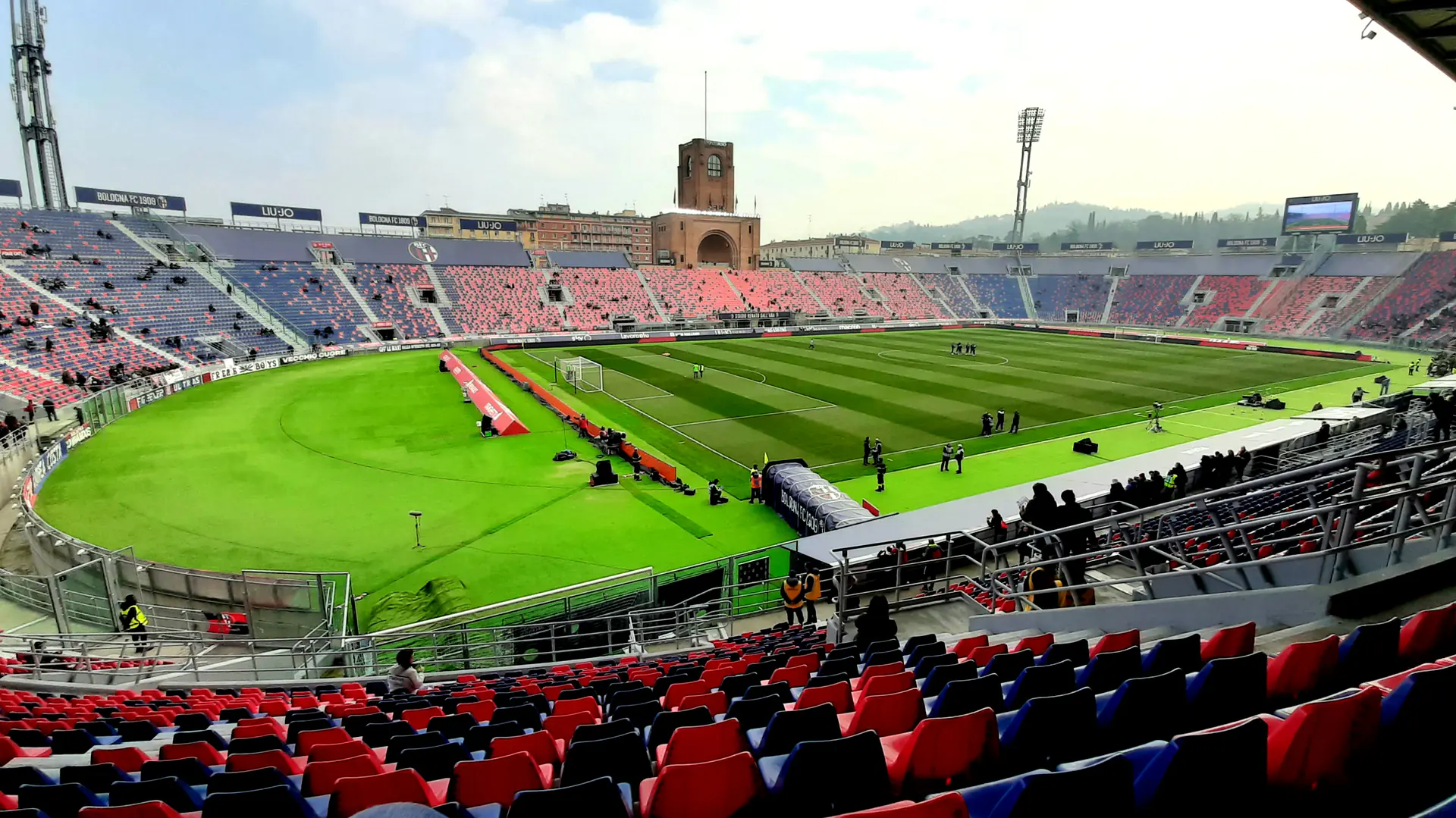
Stadio Renato Dall'Ara, hidden in the residential Saragozza district of Bologna, is one of Italian football's most architecturally distinctive grounds — a 1927 design by Giulio Ulisse Arata that pioneered the idea of folding stadium stands directly into a piece of civic architecture. The complex includes the iconic Torre di Maratona (Marathon Tower) and a swimming pool building, all in the muscular fascist-era language of the period. Home to Bologna FC 1909 since opening, the ground holds 38,279 and has hosted matches at both the 1934 and 1990 FIFA World Cups, plus a string of Italy national team fixtures and Coppa Italia knockouts.
The stadium was named after Renato Dall'Ara, Bologna's long-serving president who died on the eve of the 1964 Serie A title-decider against Inter at San Siro — a match Bologna went on to win, sealing the club's seventh Scudetto. Bologna's 2010s and 2020s renaissance under Thiago Motta and Vincenzo Italiano returned them to the Champions League for the first time since the 1960s, after a 5th-placed finish in 2023/24. With a more recent renovation completed in 2015 modernising stands and accessibility, and an ongoing debate about further redevelopment, the Dall'Ara remains a beloved working-class football cathedral within a five-minute walk of Bologna's medieval city walls. Compared to the listed-heritage formality of Stadio Franchi in Florence or the monumental scale of San Siro, the Dall'Ara is altogether more intimate — and the matchday food culture (Bologna being the gastronomic capital of Italy) is unmatched.
Key Features
- ✓Opened in 1927 as Stadio Littoriale — one of the first stadiums to integrate its stands directly into a civic architectural complex
- ✓Capacity 38,279 — home of Bologna FC 1909 since opening
- ✓Designed by Giulio Ulisse Arata, including the iconic Torre di Maratona (Marathon Tower)
- ✓Hosted matches at the 1934 and 1990 FIFA World Cups
- ✓Named in 1983 after Bologna president Renato Dall'Ara, who died on the eve of the 1964 title-decider
History
Construction of what was then called the Stadio Littoriale began in 1925 to a design by Giulio Ulisse Arata. The complex was inaugurated on 31 October 1926 with a parade by Benito Mussolini — though the football inauguration came on 29 May 1927 with a friendly between an Italy XI and Spain (2-0 to Italy). The architecturally distinctive feature was the integration of the stands into a broader civic complex including a 70-metre tower, a swimming pool and athletic facilities, all rendered in the muscular fascist-era classicism of the period.
The 1934 World Cup
The stadium hosted three matches at the inaugural Italian World Cup in 1934, including a famously brutal quarter-final between Italy and Spain that was so even it required a replay. After the war, the stadium was renamed Stadio Comunale in 1945, shedding its fascist associations while keeping the Arata-designed structures intact.
The Dall'Ara Era and Bologna's Glory Years
Renato Dall'Ara served as Bologna's president from 1934 to 1964 and presided over the club's golden era — five Serie A titles (1936, 1937, 1939, 1941 and the famous 1964 title that arrived after his sudden death two days before the playoff at San Siro). The stadium was renamed Stadio Renato Dall'Ara in 1983 in his honour, and the Bologna ultras still chant his name on big occasions. The ground was also Italy's home for several internationals through the 1950s and 60s.
The 1990 World Cup
The Dall'Ara hosted three matches at the 1990 World Cup, including a memorable group-stage tie between Italy and Czechoslovakia (2-0 to Italy). The 1990 reconfiguration removed the running track and reduced capacity from a peak of over 50,000 standing to its modern all-seated figure.
The 2015 Refurbishment and the Modern Era
A 2015 refurbishment modernised stands, hospitality, accessibility and the pitch. Under owner Joey Saputo and successive head coaches including Sinisa Mihajlovic, Thiago Motta and Vincenzo Italiano, Bologna engineered a remarkable revival from mid-table to Champions League qualifiers — finishing 5th in 2023/24 to qualify for the 2024/25 Champions League for the first time in over fifty years. Debate about a further redevelopment or new stadium continues, but for now the Dall'Ara remains the club's home — and one of Italian football's most distinctive grounds.
Tickets & Tours
How to Get Bologna FC 1909 Tickets
There are three main ways to attend a match at the Dall'Ara:
1. Official Club Tickets (Best Value)
Buy directly from bolognafc.it — general sale typically opens 2-3 weeks before kickoff. Prices range from €25 (Curva upper corners) to €140+ (Tribuna Centrale premium). Italian rules require nominative tickets with a matching photo ID. The 'Bologna Pass' membership unlocks earlier sales windows.
⚠️ Important: Champions League knockouts (now relevant again since 2024/25) and visits from Juventus, Inter, Milan, Roma/Lazio, Napoli and the Derby dell'Appennino against Fiorentina sell out before general sale.
2. Official Hospitality (Guaranteed Access)
Bologna FC hospitality at the Dall'Ara includes:
- Tribuna VIP — central premium with pre/post-match Emilian dining, from €180
- Sky Box — private suite for groups, from €400+ per person
- Premium Tribuna Centrale — lower-tier central with hospitality lounge access, from €220
Book via the Bologna hospitality desk through the official portal.
3. Third-Party Platforms (Sold-Out Matches)
For sold-out fixtures, established platforms aggregate verified resale:
- LiveFootballTickets — Serie A specialists, from €70
- SeatPick — comparison platform
⚠️ Note: Italian nominative-ticket rules mean some resale tickets cannot be legally transferred. Verify the seller can re-issue in your name.
Stadio Dall'Ara Tour
Bologna FC offers occasional stadium tours, typically around the Marathon Tower and the trophy room.
What You'll See
- Marathon Tower — Arata's 70-metre fascist-era campanile, distinct from the Franchi's tower (which was a separate Nervi design six years later)
- Home dressing room and tunnel
- Pitch-side and dugout access
- Trophy area including the seven Bologna Scudetti (1925, 1929, 1936, 1937, 1939, 1941, 1964) and the 1999 UEFA Intertoto Cup
- Architectural exhibits on Giulio Ulisse Arata's 1927 design
- The Renato Dall'Ara story — the president who died on the eve of the 1964 title decider
Practical Details
- Duration: Approximately 60-90 minutes
- Schedule: Limited matchday-week availability; typically Saturdays
- Price: Adults around €15-20
- Languages: Italian, English
- Accessibility: Improved with the 2015 refurbishment
Booking
- GetYourGuide
- Viator
- Direct: bolognafc.it
Pro tip: Combine your visit with the Portico di San Luca hike — 4 km uphill under continuous arches to the basilica with panoramic views back over Bologna and the stadium below. One of Italy's great half-day experiences.
Quick Tips
- Bring photo ID: Tickets are nominative
- Try the mortadella: Bologna is the city of origin — quality is genuinely different here
- Walking from centre: 25-minute portico walk via Via Saragozza is the best way to arrive
- Champions League: Bologna returned to Europe's top competition in 2024/25 — demand has surged
Best Seats at Stadio Dall'Ara
The Dall'Ara is a single-tier-plus-mezzanine bowl with the Curva Andrea Costa (north end), the Curva San Luca (south end, also called Curva Bulgarelli after club legend Giacomo Bulgarelli), the Tribuna (long side west, with the Marathon Tower behind) and the Distinti opposite. The Tribuna Centrale lower tier offers the best balance.
Curva Andrea Costa (North End)
Historic home of the Bologna ultras, including the Mods 1974 group — one of Italian football's longest-running ultras formations. Loud, choreographed, behind the goal. Prices typically €25-45 for Serie A. Atmosphere is unmatched among Bologna sections.
Curva San Luca / Bulgarelli (South End)
Named after the Madonna of San Luca who watches over Bologna from the hilltop sanctuary visible from the stadium. The opposite curve, traditionally allocated to away teams and additional Bologna supporters. Same architectural pattern. Prices €25-40. The away allocation typically sits in the upper section.
Tribuna (Long Side, West)
The Tribuna runs along the west long side with the Marathon Tower behind. Includes the Tribuna Centrale (premium central) and Tribuna Laterale (lateral wings). Pricing €55-100 (Lower Tier central), €40-80 (Upper Tier), with central sections most expensive. The Tribuna is the focal point of TV cameras.
Distinti (Long Side, East)
The Distinti is the opposite long side, with the dugouts and tunnel. Sections Distinti Centrale and Distinti Laterale. Pricing €45-85. Slightly less iconic but excellent views.
Premium & Hospitality
Bologna offers hospitality in the Tribuna VIP and Sky Box sections. Packages start around €180 and exceed €400 for Champions League knockouts and visits from Inter, Milan and Juventus. Book via the club hospitality team.
Accessibility
Wheelchair-accessible seating with companion seats in designated sections following the 2015 refurbishment. Lift access between levels, accessible toilets and dedicated entrances. Contact Bologna FC accessibility in advance.
Pro Tips
- Best atmosphere: Curva Andrea Costa lower
- Best balance: Tribuna Centrale, Lower Tier — Marathon Tower visible behind you
- Best photographs: Distinti upper, looking back at the Marathon Tower and San Luca hilltop
- Away fans: Curva San Luca upper section
- Champions League nights: Demand is high since Bologna's return to Europe — book early
- Family section: Distinti Centrale has designated family areas
Match Day Experience
A matchday at the Dall'Ara is one of Italian football's most welcoming experiences — a tight, intimate ground in a residential district, with Bologna's unmatched food culture and red-brick medieval streets just five minutes' walk away.
Pre-Match (2-3 hours before)
Bologna is the gastronomic capital of Italy and the pre-match food scene is part of the experience. Trattoria Anna Maria (legendary tortellini), Sfoglia Rina (handmade pasta to take away), and the Mercato delle Erbe all sit a 15-20 minute walk from the stadium. Closer to the ground, bars and trattorias along Via Andrea Costa, Via Saragozza and Piazza della Pace fill with rossoblù supporters. Bar Ferrari and Trattoria della Santa are matchday favourites. The walk from central Bologna along Via Saragozza is itself a pleasure — the historic medieval portico runs the full length, the longest covered walkway in Europe.
Inside the Stadium
Gates open roughly 90 minutes before kickoff. The first sight from the upper Tribuna is striking — the Marathon Tower behind you, the Sanctuary of San Luca on its hill in the distance, the integrated swimming pool building visible on the perimeter. Pre-match anthems include the Bologna 'Inno' by Carlo Alberto Rossi, the iconic 'Forza Bologna alé' chant, and the Curva Andrea Costa's relentless 'Rossoblù' chanting throughout matches. Champions League nights add the UEFA anthem and elaborate Curva tifos — a recent novelty after fifty-plus years away from the competition.
Food & Drink
Concession kiosks sell Emilian matchday fare — crescentine (Bologna's fried bread, served with cured meats and squacquerone cheese), piadine, panini con mortadella (you must try the local mortadella in its city of origin), tortellini in brodo in winter, plus Peroni and Birra Moretti. Prices reasonable (around €5-7). Hospitality areas offer Emilian tasting menus with Lambrusco wine.
After the Match
Post-match crowds funnel toward central Bologna along Via Saragozza and Via Andrea Costa. Walking back to Piazza Maggiore takes 20-25 minutes through the medieval porticoes. The city centre stays lively until late — Osteria del Sole (Bologna's oldest osteria, bring your own food), Trattoria di Via Serra, and the University Quarter around Via Petroni for younger crowds. Bologna's nightlife is excellent.
International Visitor Tips: Italian rules require nominative tickets matched to a photo ID. Combine the matchday with Bologna's food culture — book a long lunch at a traditional trattoria (Trattoria Anna Maria, Trattoria di Via Serra, Da Cesari) for tortellini in brodo, tagliatelle al ragù and mortadella. The walk back along the Portico di San Luca to the basilica on the hill is one of Italy's great hikes (4 km uphill under continuous arches).
Bag Policy & Prohibited Items
⚠️ Important: Bologna's 2025 ground regulations are unusually clear about weather and about seating, and less specific about bag sizes than you might expect.
No dimension is published, so a small bag searched at the gate is the practical limit and anything larger is a gamble. There is no deposit at the Dall'Ara.
When rain is falling or forecast, umbrellas with spikes or large umbrellas are refused. That is written into the regulations rather than left to stewards, and Bologna gets plenty of both autumn and spring rain.
Bring photo ID, which is checked against your ticket, and keep the ticket on you until you leave — staff can ask to see it at any point inside the ground, not just on the way in. You must sit in the seat printed on it; taking a vacant seat elsewhere without permission is grounds for ejection.
Banners must be non-rigid and no larger than 42 x 60cm, team flags up to 50 x 70cm on poles no longer than a metre, and drums or megaphones need advance authorisation from the safety group.
Getting There
🚇 Metro
Bologna has no metro. The closest public-transport stop is the regional rail at Bologna Centrale, then bus or taxi (15-20 minutes). The People Mover elevated rail connects the airport to Bologna Centrale in 7 minutes for visitors flying in.
🚌 Bus
TPER bus lines 14 and 21 serve Via Andrea Costa / Piazza della Pace directly outside the stadium. From central Bologna (Piazza Maggiore), the journey is 15-20 minutes. The Saragozza line via the medieval portico is the most scenic. TPER runs extra services on matchdays.
🅿️ Parking
Very limited parking on matchdays — surrounding streets operate residents-only zones. Best options are Parcheggio Saragozza and the parking areas around Ospedale Maggiore (€2-3/hour) with a 10-minute walk. Most fans use public transport or walk from the centre.
🚶 From City Center
The Dall'Ara is ~1.5 km west of central Bologna (Piazza Maggiore) — a 20-25 minute walk under the medieval portico of Via Saragozza, the longest continuous covered walkway in Europe. A taxi from the centre costs around €8-12. Uber Black and FreeNow operate in Bologna but Bologna's walkable centre makes them rarely necessary.
Where to Stay for Stadio Dall'Ara
Near the Stadium (Saragozza)
Search hotels near Dall'Ara
The Saragozza district is quietly residential, with the medieval portico to the basilica on the hill. Most visitors stay in central Bologna for the food and architecture, walking or busing to the stadium.
Best Western Hotel Re Enzo (Saragozza, 1 km)
Three-star within walking distance of the stadium and the medieval portico. Comfortable rooms, on-site restaurant. Practical for match-focused trips.
Bologna Historic Centre (Recommended)
Search hotels in central Bologna
For most visitors, central Bologna around Piazza Maggiore, Via dell'Indipendenza or the University Quarter is the better choice — walking distance to the Due Torri, San Petronio basilica, the Quadrilatero food market and the world's oldest university, with a 20-25 minute portico walk to the stadium.
Grand Hotel Majestic 'già Baglioni' (centre, 1.5 km)
Five-star in a converted 18th-century palace just off Piazza Maggiore. The benchmark luxury option in Bologna with a famous interior and the Café Marinetti for an aperitivo.
Hotel Corona d'Oro (centre, 1.3 km)
Four-star in a converted medieval palazzo with original frescoes preserved. Excellent service, classic Bolognese ambience, and walking distance to both the stadium (20 min) and the city's food scene.
Aemilia Hotel (University Quarter, 1.7 km)
Four-star modern in the lively student district. More affordable than the central five-stars, with the nightlife and the more authentic Bolognese trattorias right outside.
Our Recommendation
For most visitors, stay in central Bologna — the food, the medieval architecture and the matchday walk under the Saragozza portico make this a complete experience. Stadium-area hotels make sense only for purely match-focused trips. Bologna is also Italy's transport hub — perfect for combining a Dall'Ara match with onward trips to Florence, Modena or Parma.
Frequently Asked Questions
Bologna tickets at the Dall'Ara typically range from €25 (Curva upper corners) to €140+ (Tribuna Centrale premium). Champions League knockouts (relevant again since 2024/25) and visits from Juventus, Inter, Milan, Roma or Napoli are heavily oversubscribed and often only available via hospitality (from ~€180) or the secondary market. Stadium tours, when offered, are €15-20.
Buy directly from bolognafc.it/en/tickets. Italian rules require nominative tickets matched to a photo ID, so the secondary market is risky unless the seller can legally re-issue in your name. The 'Bologna Pass' membership unlocks earlier sales windows.
The stadium was renamed Stadio Renato Dall'Ara in 1983 in honour of the late Bologna president, who served the club from 1934 to 1964 and presided over its golden era of five Scudetti. Dall'Ara died on 3 June 1964 — two days before Bologna's championship playoff against Inter at San Siro, which Bologna won 2-0 to claim the title.
Yes, Bologna FC offers occasional stadium tours including the Marathon Tower, dressing rooms, pitch-side and the trophy area with the seven Bologna Scudetti and the 1999 UEFA Intertoto Cup. Adults around €15-20, 60-90 minutes. Limited availability — check bolognafc.it before your visit.
Bologna publish no bag dimension, so treat a small searched bag as the limit; there is no deposit at the Dall'Ara. When rain is falling or forecast, umbrellas with spikes or large ones are refused. Bring photo ID, keep your ticket on you until you leave, and sit in the seat printed on it.
The Dall'Ara is a 20-25 minute walk west of central Bologna under the medieval portico of Via Saragozza — the longest continuous covered walkway in Europe and a Bologna landmark in itself. TPER bus lines 14 and 21 also serve Via Andrea Costa directly outside the stadium (15-20 minutes from Piazza Maggiore). Taxis cost €8-12.
For most visitors, central Bologna around Piazza Maggiore or the University Quarter is the best base — walking distance to the Due Torri, the Quadrilatero food market, and a 20-25 minute portico walk to the stadium. Bologna's food culture makes this the most rewarding base. Stadium-area hotels in Saragozza make sense only for purely match-focused trips.
Stadio Renato Dall'Ara has a capacity of 38,279. The current configuration dates from the 1990 World Cup reconfiguration to all-seated and the 2015 refurbishment; the original 1927 stadium had a peak capacity of over 50,000 standing.
Details on this page can change without much notice, and cup or European fixtures often run different rules. Last reviewed 10 August 2026 — worth confirming anything important with the club before you travel.
Related Stadiums
Other stadiums in Serie A
Tickets & Tours
Stadium Name History
Visit www.stadiumseeker.com for tickets, tours, and interactive maps