Parma, Italy
Overview
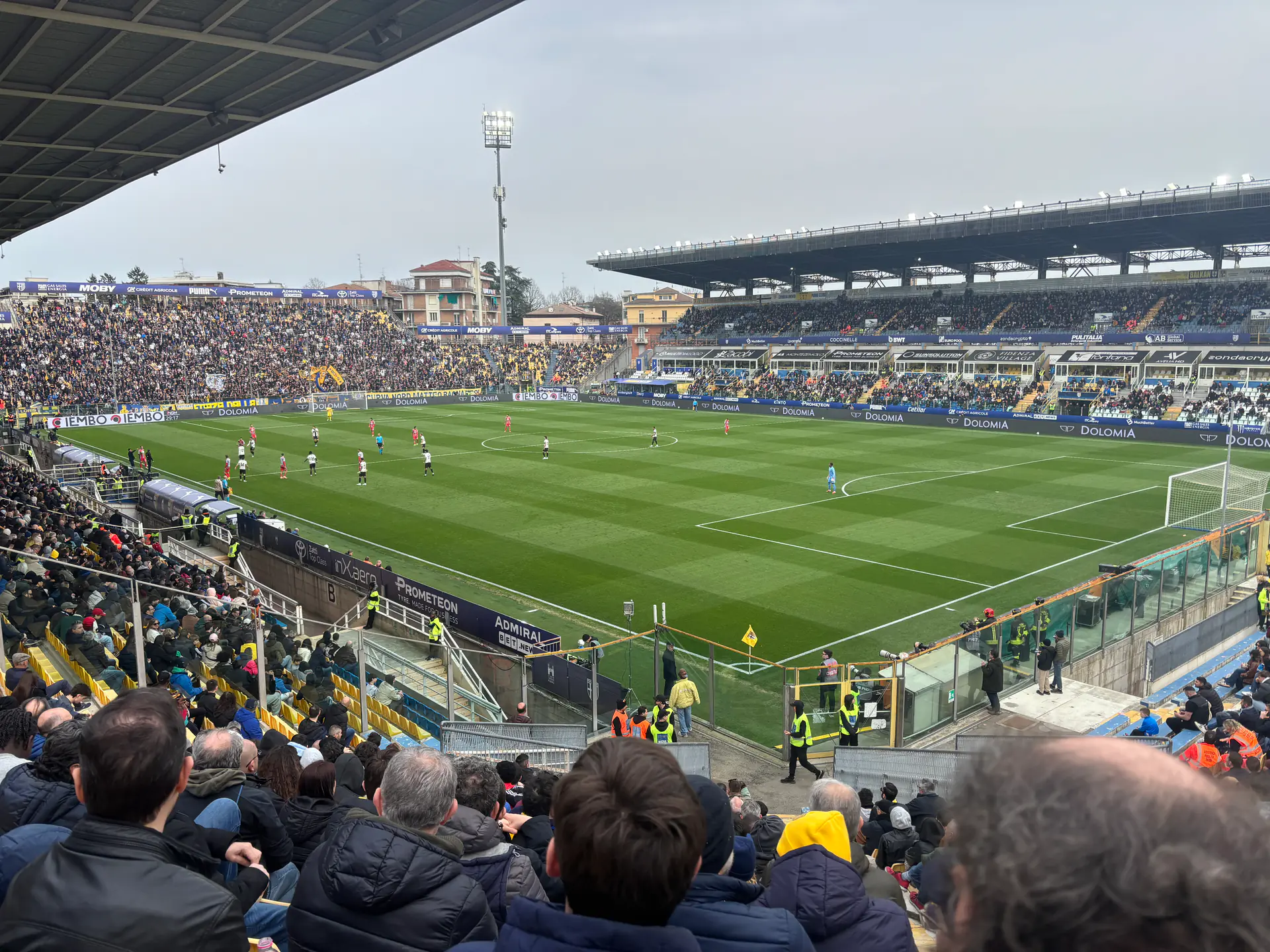
The Stadio Ennio Tardini, the sixth-oldest football ground still in use in Italy (after grounds like Ferraris), is the home of Parma Calcio 1913 since 1923. Located 1.5 km south-east of Parma's medieval centre, the stadium holds 22,352 and combines the muscular pre-fascist 1920s architecture of architect Ettore Leoni with stands rebuilt across 1990-1993 to a near-doubled capacity. Named after Ennio Tardini, the early Parma president who died of pneumonia shortly after the stadium's 1922 groundbreaking, the ground has been continuously associated with Parma football for over a century.
Parma's footballing history is one of football's most dramatic recent stories. Under owner Calisto Tanzi (and his Parmalat dairy empire), the club rose from Serie B in 1990 to win the 1992 Coppa Italia, the 1993 UEFA Cup Winners' Cup (beating Antwerp 3-1 in the final at Wembley), the 1995 UEFA Cup, the 1999 UEFA Cup, and the 2002 Coppa Italia — making Parma one of the great mid-1990s European clubs alongside the bigger Italian giants. The 2003 Parmalat scandal triggered a long collapse including bankruptcy and re-founding as 'Parma Calcio 1913' in 2015, dropping the club to Serie D before rebuilding back to Serie A. Promotion at the end of 2023/24 returned Parma to Serie A for 2024/25, and the Tardini hosts another generation of Parma football. Despite its age, the stadium has faced UEFA-standards challenges including seat specifications that limit its eligibility for European competition — a constraint future plans aim to address.
Key Features
- ✓Sixth-oldest football ground still in use in Italy — opened 1923
- ✓Home of Parma Calcio 1913 since opening; capacity 22,352
- ✓Designed by Ettore Leoni; major reconstruction 1990-1993 nearly doubled the capacity
- ✓Named after Ennio Tardini, the early Parma president who died shortly after the stadium's 1922 groundbreaking
- ✓Stage of Parma's 1990s European glory era — 1993 Cup Winners' Cup, 1995 and 1999 UEFA Cups
History
The stadium opened on 16 September 1923 as the Stadio Ennio Tardini, named after the early Parma president who had died of pneumonia shortly after the November 1922 groundbreaking. Designed by Ettore Leoni in the late-historicist style typical of early-1920s Italian civic architecture (predating the fascist rationalist movement), the original ground had a capacity of around 8,000 and the now-famous Tribuna Petitot stand named after a 19th-century Parma writer.
The Tardini's First 60 Years
Parma football's first six decades at the Tardini were largely played in Serie B and Serie C, with occasional brief Serie A appearances. The stadium was used for cycling and athletics events alongside football — typical of multi-purpose Italian municipal grounds. The original cycling track was converted to athletics use in 1935. Capacity grew modestly over the decades through additional stands but the ground remained essentially the 1920s Leoni design until the early 1990s.
The 1990-1993 Reconstruction and the Tanzi Era
Under owner Calisto Tanzi (whose Parmalat dairy empire underwrote unprecedented investment), Parma's rise from Serie B 1990 to UEFA Cup glory necessitated a major stadium reconstruction. From 1990 to 1993, the Tardini was substantially rebuilt — the original capacity of around 13,500 was almost doubled to approximately 29,050 with new stands. The reconstruction kept the Tribuna Petitot as the heritage stand, with the other three sides modernised. The stadium became a regular European venue across the 1990s and early 2000s as Parma won:
- Coppa Italia 1992 and 2002
- UEFA Cup Winners' Cup 1993 (beating Antwerp 3-1 at Wembley in the final)
- UEFA Cup 1995 (beating Juventus 2-1 on aggregate in an all-Italian final)
- UEFA Cup 1999 (beating Marseille 3-0 in the final in Moscow)
Players including Faustino Asprilla, Gianfranco Zola, Hernán Crespo, Hristo Stoichkov, Buffon, Cannavaro and Thuram passed through. The Tardini's atmosphere on European nights — particularly the 1993 Cup Winners' Cup run — remains a romantic memory of mid-1990s Italian football.
The 2003 Parmalat Collapse
The 2003 Parmalat scandal (a €14 billion accounting fraud at the Tanzi-controlled dairy empire) triggered a 12-year decline. Parma's parent company collapsed, the club passed through multiple administrations, and in 2015 the historic Parma F.C. was declared bankrupt. A reborn Parma Calcio 1913 was admitted to Serie D, the fourth tier — a humiliating fall from European glory.
The 2015-2024 Climb Back and the 2024/25 Serie A Return
Under American ownership (the Krause Group from 2020) and successive coaches, Parma rebuilt through the divisions — promotion from Serie D in 2016, from Serie C in 2017, from Serie B in 2018, brief Serie A appearance, relegation in 2020/21, and finally a Serie B title in 2023/24 that returned Parma to the top flight for 2024/25. The Tardini hosted another generation of Parma football, with the historic Tribuna Petitot still in place a century after its construction.
UEFA Standards and Future Plans
The Tardini's age has created UEFA-standards challenges. Seat specifications fall short of UEFA Category 4 requirements, limiting Parma's ability to host European competition matches at the ground. Phased renovation plans are under discussion to address this without sacrificing the heritage architecture of the Tribuna Petitot.
Tickets & Tours
How to Get Parma Calcio 1913 Tickets
There are three main ways to attend a match at the Tardini:
1. Official Club Tickets (Best Value)
Buy directly from parmacalcio1913.com — general sale typically opens 2-3 weeks before kickoff. Prices range from €20 (Curva upper) to €140+ (Tribuna Petitot premium). Italian rules require nominative tickets with a matching photo ID.
⚠️ Important: Visits from Juventus, Inter, Milan, Napoli and Roma sell out before general sale.
2. Official Hospitality (Guaranteed Access)
Parma hospitality at the Tardini:
- Tribuna Petitot Premium — central premium with Parma tasting menu (prosciutto, Parmigiano, Lambrusco) pre/post-match, from €180
- Sky Box — private suite for groups, from €400+ per person
- Tribuna VIP — central lower-tier with hospitality lounge access, from €220
Book via the Parma hospitality desk through the official portal.
3. Third-Party Platforms (Sold-Out Matches)
For sold-out fixtures:
- LiveFootballTickets — Serie A specialists, from €60
- SeatPick — comparison platform
⚠️ Note: Italian nominative-ticket rules mean some resale tickets cannot be legally transferred. Verify the seller can re-issue in your name.
Stadio Tardini Tour
Parma offers occasional stadium tours focused on the historic Tribuna Petitot and the 1990s European glory era.
What You'll See
- The 1990s European glory exhibits — 1993 Cup Winners' Cup, 1995 and 1999 UEFA Cup memorabilia, the Asprilla-Crespo-Stoichkov era
- Tribuna Petitot — the architectural heritage stand from the original 1923 ground
- Home dressing room and tunnel
- Pitch-side and dugout access
- Parmalat scandal and refoundation — Parma's collapse and rise from Serie D
- Krause Group ownership — the modern American-led era
Practical Details
- Duration: Approximately 60-75 minutes
- Schedule: Limited; typically Saturdays
- Price: Adults around €15-20
- Languages: Italian, English
Booking
- GetYourGuide
- Viator
- Direct: parmacalcio1913.com
Pro tip: Combine the matchday with a Food Valley day-trip — Parmigiano-Reggiano dairies (early morning), prosciutto di Parma producers (mid-morning), and balsamic vinegar ageing rooms in nearby Modena. The food experiences are among Italy's most rewarding.
Quick Tips
- Bring photo ID: Tickets are nominative
- Food Valley capital: No Italian football trip combines better with gastronomy
- Heritage architecture: The Tribuna Petitot is one of the oldest surviving football stand structures in Italy
- Combine with Bologna or Modena: 50 minutes and 30 minutes respectively by train
Best Seats at Stadio Tardini
The ground is a four-stand bowl with the Curva Nord at one end (home of the Parma ultras), the Curva Sud opposite, the historic Tribuna Petitot along one long side and the Tribuna Pubblico opposite. The Tribuna Petitot is the architectural heritage stand.
Curva Nord (North End)
Historic home of the Parma ultras including the Boys Parma 1977 group. Behind the goal. Prices typically €20-40 for Serie A. Atmosphere is excellent given the size — Parma's tifoseria has been through the Parmalat collapse and refoundation, and the curva culture remains intense.
Curva Sud (South End)
The opposite curve, traditionally allocated to away teams and additional Parma supporters. Prices €20-35.
Tribuna Petitot (Long Side, West — Historic)
The Tribuna Petitot is the architectural heritage stand from the original 1923 ground, retained through the 1990-1993 reconstruction. Named after Petitot, a 19th-century Parma writer. Houses the dressing room tunnel and the dugouts. Pricing €60-110 (Lower Tier central), €45-85 (Upper Tier), with central sections most expensive.
Tribuna Pubblico (Long Side, East)
The Tribuna Pubblico is the opposite long side, rebuilt in 1990-1993. Pricing €40-80.
Premium & Hospitality
Parma offers hospitality in the Tribuna Petitot and Sky Box sections. Packages start around €180 and exceed €400 for visits from Juventus, Inter, Milan and Napoli. Book via the club hospitality desk.
Accessibility
Wheelchair-accessible seating with companion seats. Lift access between levels following the 1990-1993 reconstruction.
Pro Tips
- Best atmosphere: Curva Nord lower tier
- Best balance: Tribuna Petitot central, Lower Tier — heritage 1923 architecture above
- Best photographs: Tribuna Pubblico upper, looking back at the historic Tribuna Petitot
- Away fans: Curva Sud upper
- Heritage interest: The Tribuna Petitot is one of the oldest surviving football stand structures in Italy
Match Day Experience
A matchday at the Tardini is one of Italian football's most food-culturally rewarding experiences — Parma is the gastronomic capital of Italy's 'Food Valley', the home of Parma ham, Parmigiano-Reggiano cheese and Lambrusco wine, and the matchday experience is as much about the food as the football.
Pre-Match (2-3 hours before)
Parma's medieval centre is a 15-minute walk from the stadium. Bars and trattorias around Piazza Garibaldi, Via della Repubblica and the Battistero di Parma fill with gialloblù-clad supporters. Try Trattoria Sorelle Picchi for traditional Parma cuisine including tortelli di erbette (herb-filled pasta), anolini in brodo and the world-famous prosciutto di Parma, or Pepèn for legendary porchetta sandwiches. Sample the local Parmigiano-Reggiano at the Mercato Centrale. Local Lambrusco wine is the matchday drink. Most fans walk from the centre via Via Massimo d'Azeglio.
Inside the Stadium
Gates open roughly 90 minutes before kickoff. The Tribuna Petitot's pre-WWI architecture is visible on the west side. Pre-match anthems include 'Forza Parma', 'Gialloblù' (Parma's yellow-and-blue colours) and the iconic 'Inno del Parma'. The Curva Nord leads relentless singing — Parma's tifoseria has been through the Parmalat collapse and refoundation, giving the curva culture a distinctive resilience.
Food & Drink
Concession kiosks sell Parma matchday fare — panini con prosciutto di Parma (essential — try the local original), tortelli, piadine, erbazzone, plus Lambrusco and Birra Moretti. Prices reasonable (around €5-7, with the prosciutto sandwich often a few euros more for quality). Hospitality areas offer Parma tasting menus.
After the Match
Post-match crowds funnel toward central Parma via Via d'Azeglio. The centro storico stays animated until late — Piazza Garibaldi and the Borgo del Naviglio are excellent for post-match aperitivo and dinner. Parma is one of the best food cities in Italy — a long matchday dinner is essential.
International Visitor Tips: Italian rules require nominative tickets matched to a photo ID. Combine the matchday with Parma's UNESCO-listed Battistero (the 12th-century baptistery with stunning frescoes), the Teatro Farnese (Italy's oldest surviving Baroque theatre) and the Galleria Nazionale (Correggio masterpieces). The Food Valley day-trips — Parmigiano-Reggiano dairies, prosciutto di Parma producers, balsamic vinegar ageing rooms — are among Italy's most rewarding gastronomic experiences. Parma pairs naturally with Bologna (50 minutes by train) and Modena on a Food Valley football weekend.
Bag Policy & Prohibited Items
⚠️ Important: Parma's stadium regulations ban backpacks and large bags outright, and the club goes further than most in advising against bringing a bulky bag at all.
No dimension is published, so a small bag is the working limit and there is no deposit at the Tardini. The ground is a short walk from Parma's centre, which makes this easy to plan around: leave anything bulky at your hotel or at the station rather than carrying it across town and discovering the problem at the turnstile.
Searches are thorough. Buying a ticket grants the club the right to check you and any bags or containers you carry, by steward and by metal detector, and the club can refuse entry to anyone declining the check.
Bring photo ID, which is checked against your ticket. Smoking is banned throughout the ground, including the concourses and open areas, not only the stands.
Getting There
🚇 Metro
Parma has no metro. The closest public-transport hub is Parma railway station, 2 km from the stadium. Direct trains from Bologna (50 minutes), Milan (1 hour) and Florence (1.5 hours).
🚌 Bus
TEP bus lines 9, 10 and 13 serve Viale Partigiani d'Italia outside the stadium. From central Parma (Piazza Garibaldi), journey time is 10-15 minutes. TEP runs extra services on matchdays.
🅿️ Parking
Limited parking on matchdays. Best options are the surrounding lots and Parcheggio Toschi (€2-3/hour) with a 10-minute walk. Parma's compact city makes walking from the centre the easier option.
🚶 From City Center
The Tardini is ~1.5 km south-east of central Parma (Piazza Garibaldi) — a 15-20 minute walk via Via Massimo d'Azeglio. A taxi costs around €7-10. The walk passes through Parma's elegant 19th-century streets.
Where to Stay for Stadio Tardini
Near the Stadium / Parma Centro Storico (Recommended)
Search hotels in central Parma
For most visitors, central Parma around Piazza Garibaldi, Strada Cavour or the Battistero is the natural base — walking distance to the stadium, the Food Valley dining scene and Parma's medieval and Renaissance heritage.
Grand Hotel de la Ville (Piazzale Boito, 1 km)
Four-star landmark hotel walking distance to both the stadium (15 minutes) and the centro storico. Classic Parma elegance, excellent restaurant.
Hotel Stendhal (Piazza della Pace, 1.5 km)
Four-star in a converted historic building near the Palazzo della Pilotta. Atmospheric base for combining football with Parma's Renaissance heritage.
Hotel Verdi (Via Pasini, 1.5 km)
Four-star boutique hotel near Parma's opera house (Teatro Regio). Excellent location for combining football with Parma's musical heritage.
B&B Hotel Parma (railway station area, 2 km)
Mid-range chain near Parma railway station. Practical for visitors arriving by train.
Food Valley Stays (For the Full Experience)
For longer stays, agriturismo options in the Food Valley countryside (Parmigiano-Reggiano farms with rooms, prosciutto di Parma producers with hospitality) offer extraordinary gastronomic experiences. Antica Corte Pallavicina in Polesine Parmense is a Michelin-starred relais with culatello ageing rooms.
Our Recommendation
For most visitors, stay in central Parma — the city is one of Europe's most underrated culinary destinations and the Tardini is a 15-minute walk from the centro storico. The Grand Hotel de la Ville and Hotel Stendhal are atmospheric central choices. Parma also pairs naturally with Bologna (50 minutes by train) and Reggio Emilia (30 minutes by train) for an Emilian Food Valley football weekend.
Frequently Asked Questions
Parma tickets at the Tardini typically range from €20 (Curva upper) to €140+ (Tribuna Petitot premium). Visits from Juventus, Inter, Milan, Napoli or Roma are oversubscribed and often only available via hospitality (from ~€180) or the secondary market. Stadium tours are €15-20.
Buy directly from parmacalcio1913.com/en/tickets. Italian rules require nominative tickets matched to a photo ID, so the secondary market is risky unless the seller can legally re-issue in your name.
The stadium was named in 1923 in honour of Ennio Tardini, the early Parma president who oversaw the stadium project and died of pneumonia shortly after the November 1922 groundbreaking. The Tribuna Petitot stand within the stadium is named separately after Petitot, a 19th-century Parma writer.
The Tribuna Petitot is the historic main stand of the Stadio Tardini, dating from the original 1923 construction by architect Ettore Leoni. It was retained through the 1990-1993 reconstruction that modernised the other three sides, making it one of the oldest surviving football stand structures in Italy. The name honours Petitot, a 19th-century Parma writer.
Yes, Parma Calcio offers occasional stadium tours focused on the 1990s European glory era (1993 Cup Winners' Cup, 1995 and 1999 UEFA Cup), the historic Tribuna Petitot heritage architecture, and the Parmalat collapse-and-refoundation story. Adults around €15-20, 60-75 minutes. Limited availability — check parmacalcio1913.com.
Backpacks and large bags are banned outright at the Tardini, and no dimension is published, so keep to a small bag. There is no deposit — leave anything bulky in the centre, which is a short walk away. Searches use stewards and metal detectors, photo ID is checked against your ticket, and smoking is banned throughout.
For most visitors, central Parma near Piazza Garibaldi or the Battistero is the best base — walking distance to the stadium and the city's medieval and Renaissance heritage. Parma is also the gastronomic capital of Italy's Food Valley — a long matchday dinner with prosciutto di Parma, Parmigiano-Reggiano and Lambrusco is essential. The Grand Hotel de la Ville and Hotel Stendhal are excellent atmospheric central choices.
The Stadio Ennio Tardini has a capacity of 22,352. The current configuration dates from the 1990-1993 reconstruction that nearly doubled the original 1923 capacity of around 13,500. The historic Tribuna Petitot stand was retained from the original Ettore Leoni design.
Details on this page can change without much notice, and cup or European fixtures often run different rules. Last reviewed 10 August 2026 — worth confirming anything important with the club before you travel.
Related Stadiums
Other stadiums in Serie A
Tickets & Tours
Stadium Name History
Visit www.stadiumseeker.com for tickets, tours, and interactive maps