Reggio Emilia, Italy
Overview
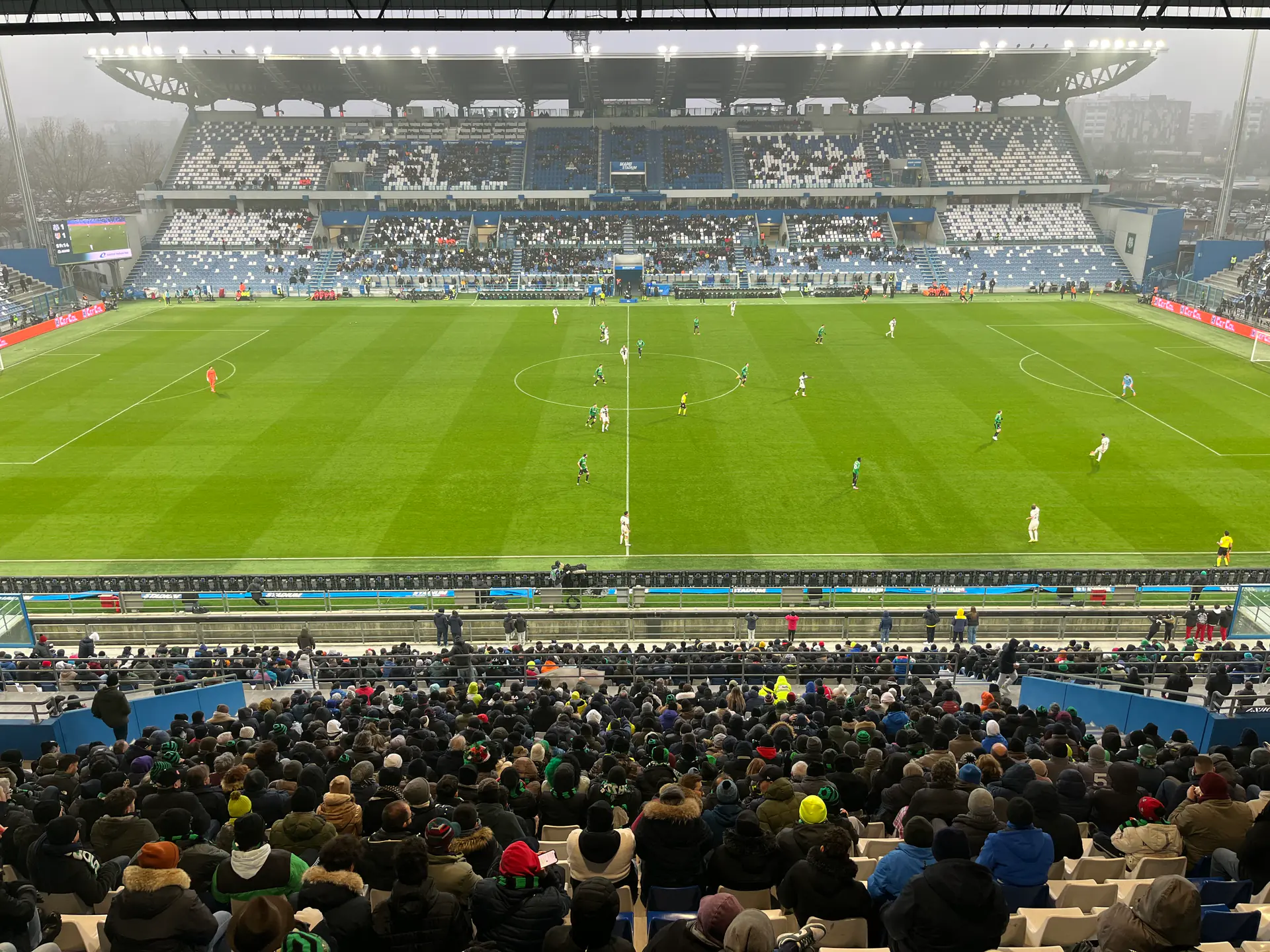
The Mapei Stadium – Città del Tricolore is the unusual home of US Sassuolo Calcio (a 25-minute train ride from Stadio Dall'Ara), who play their Serie A football 24 km away from the small town of Sassuolo itself, in the larger city of Reggio Emilia. Owned since 2013 by the Mapei chemicals company — headquartered in Sassuolo and the long-running sponsor that propelled the club from amateur leagues to Serie A — the stadium has a capacity of 21,515 and is genuinely shared with AC Reggiana, the historic Reggio Emilia club. Opened in 1995 as the Stadio Giglio, the ground is the only Italian stadium with a water-filled moat between the pitch and the stands (originally built to prevent the pitch invasions then common in Italian football).
Reggio Emilia is famous as the 'Città del Tricolore' — the place where the Italian flag was first adopted in 1797 — and the stadium's secondary name honours that civic heritage. The Sassuolo presence in Reggio Emilia has been controversial among Reggiana supporters, who view the arrangement as their city hosting another club's first team while their own historic team plays in lower divisions. Sassuolo's Mapei era (since 2013) has seen the club establish itself as a Serie A regular, with European football reached in 2015/16 (Europa League qualifier round, lost to Athletic Bilbao) and 2016/17 (Europa League group stage, beating Athletic Bilbao home and away). Sassuolo were relegated to Serie B at the end of 2023/24 but returned for 2025/26 — making the Mapei Stadium once again a Serie A venue. The ground has also hosted the 2016 UEFA Women's Champions League Final, the 2020 Supercoppa Italiana and the 2021 Coppa Italia Final.
Key Features
- ✓Shared home of US Sassuolo Calcio (Serie A) and AC Reggiana since 1995/2013 respectively
- ✓Capacity 21,515 — owned by Mapei (the chemicals company that sponsors Sassuolo) since 2013
- ✓Only Italian stadium with a water-filled moat between pitch and stands (anti-pitch-invasion measure)
- ✓Hosted the 2016 UEFA Women's Champions League Final, 2020 Supercoppa Italiana and 2021 Coppa Italia Final
- ✓Reggio Emilia is the 'Città del Tricolore' — birthplace of the Italian flag in 1797
History
The stadium opened on 20 April 1995 as the Stadio Giglio, named after the lily (giglio) that features in Reggio Emilia's civic crest. It was built primarily for AC Reggiana, the city's historic football club, who had recently risen to Serie A and needed a modern ground. The original capacity was around 21,500 with a single-tier bowl design and the famous water-filled moat — built to prevent the kind of pitch invasions that plagued Italian football in the early 1990s.
Reggiana's Decline and the 2012 Renaming
AC Reggiana suffered repeated financial difficulties through the 2000s, dropping into the lower divisions and entering bankruptcy proceedings. The stadium passed into different ownerships before being acquired by Mapei in 2013. Before then, in 2012, the ground was renamed Stadio Città del Tricolore in honour of Reggio Emilia's status as the birthplace of the Italian flag (the tricolore was first formally adopted in Reggio on 7 January 1797 by the Cispadane Republic).
Mapei's Acquisition and Sassuolo's Move (2013)
When US Sassuolo Calcio achieved their first-ever Serie A promotion at the end of 2012/13, they needed a Serie A-standard stadium — Sassuolo's own town doesn't have a suitable venue. Mapei (the global construction-chemicals company headquartered in Sassuolo, which had been Sassuolo Calcio's main backer since 2002 and would acquire the club) bought the Reggio Emilia stadium and renamed it the Mapei Stadium – Città del Tricolore in 2013. Sassuolo moved in for the 2013/14 Serie A season, sharing with Reggiana. The arrangement remains contentious among Reggiana supporters.
Sassuolo's European Era and the Reggiana Cohabitation
Sassuolo established themselves as a Serie A mainstay from 2013 onwards. The 2015/16 season's 6th-place finish brought European qualification — Sassuolo reached the Europa League group stage in 2016/17, beating Athletic Bilbao both home and away. Players including Domenico Berardi, Manuel Locatelli and Davide Frattesi emerged from the Sassuolo academy and the Mapei Stadium. Reggiana have continued to play home matches at the stadium, generally in Serie B or Serie C, providing the unusual situation of two clubs sharing one ground from different divisions.
Major Match Hosting
The Mapei Stadium has hosted prestigious neutral-venue matches: the 2016 UEFA Women's Champions League Final (won by Lyon over Wolfsburg), the 2020 Supercoppa Italiana (Napoli vs Juventus) and the 2021 Coppa Italia Final (Juventus vs Atalanta). Italy national team friendlies have also been played here.
Sassuolo's 2024 Relegation and 2025/26 Return
At the end of 2023/24, Sassuolo were relegated to Serie B after a 11-season Serie A run. They won promotion at the end of 2024/25 and returned to Serie A for 2025/26 — restoring the Mapei Stadium to top-flight status alongside Reggiana's Serie B matches.
Tickets & Tours
How to Get Sassuolo Tickets
There are three main ways to attend a Sassuolo match at the Mapei Stadium:
1. Official Club Tickets (Best Value)
Buy directly from sassuolocalcio.it — general sale typically opens 2-3 weeks before kickoff. Prices range from €20 (Curva upper corners) to €120+ (Tribuna VIP central). Italian rules require nominative tickets with a matching photo ID.
⚠️ Important: Visits from Juventus, Inter, Milan, Napoli and Roma sell out before general sale.
For Reggiana home matches (Serie B/C), buy via reggiana1919.it.
2. Official Hospitality (Guaranteed Access)
Sassuolo hospitality at the Mapei Stadium:
- Tribuna VIP — central premium with pre/post-match Emilian dining, from €150
- Premium Centrale — central lower-tier, from €200
Book via the Sassuolo hospitality desk through the official portal.
3. Third-Party Platforms (Sold-Out Matches)
For sold-out fixtures:
- LiveFootballTickets — Serie A specialists, from €50
- SeatPick — comparison platform
⚠️ Note: Italian nominative-ticket rules mean some resale tickets cannot be legally transferred. Verify the seller can re-issue in your name.
Mapei Stadium Tour
Sassuolo and the Mapei Stadium offer occasional tours focused on the unusual shared-tenancy story and the famous water-filled moat.
What You'll See
- The famous water moat — the only one in Italian football, built in 1995 to prevent pitch invasions
- Sassuolo's European era exhibits — 2016/17 Europa League run including the Athletic Bilbao victories
- Reggiana club history — including the 1990s Serie A era when the stadium was originally built
- Home dressing room and tunnel
- Pitch-side and dugout access
- 2016 UEFA Women's Champions League Final memorabilia
Practical Details
- Duration: Approximately 60 minutes
- Schedule: Limited; typically Saturdays
- Price: Adults around €12-18
- Languages: Italian, English (variable)
Booking
- GetYourGuide
- Viator
- Direct: sassuolocalcio.it
Pro tip: Reggio Emilia's 'Sala del Tricolore' — the literal birthplace of the Italian flag — is a 25-minute walk from the stadium and worth combining with a matchday visit. The civic museum is free to enter.
Quick Tips
- Bring photo ID: Tickets are nominative
- Unusual setting: Sassuolo's stadium is in Reggio Emilia, not Sassuolo — the only such arrangement in Serie A
- Combine with Bologna: Reggio Emilia is 25 minutes by train from Bologna — easy combination with Stadio Dall'Ara
- Watch the moat: The stadium's signature feature is genuinely unique
Best Seats at Mapei Stadium
The ground is a single-tier bowl with the Curva Nord at one end (typically allocated to home Sassuolo supporters when Sassuolo are home), the Curva Sud opposite, the Tribuna Centrale along one long side and the Distinti opposite. The water-filled moat between pitch and stands gives every section an unusual viewing geometry.
Curva Nord (North End)
The traditional home end for Sassuolo supporters when Sassuolo are the home team, with the Curva Nord neroverdi (Sassuolo's black-and-green colours) leading singing. When Reggiana are the home team, the curva allocations swap. Prices typically €20-40 for Serie A. Atmosphere is modest by Italian standards — Sassuolo's small support base and the arrangement's controversy among Reggiana fans creates a slightly subdued curva.
Curva Sud (South End)
The opposite curve, allocated to away teams and additional Sassuolo supporters. Prices €20-35. Away allocation typically in the upper section.
Tribuna Centrale (Long Side, West)
The Tribuna Centrale runs along the west long side with the dressing room tunnel below. Includes Tribuna VIP (premium central). Pricing €50-100 (Lower Tier central), €35-65 (Upper Tier), with central sections most expensive. Best architectural views.
Distinti (Long Side, East)
The Distinti is the opposite long side. Pricing €40-70. Slightly more affordable.
Premium & Hospitality
Sassuolo offers hospitality in the Tribuna VIP. Packages start around €150 and exceed €350 for visits from Inter, Milan, Juventus and Napoli. Book via the Sassuolo hospitality desk.
Accessibility
Wheelchair-accessible seating with companion seats. The single-tier design makes accessibility straightforward. Contact Sassuolo accessibility in advance.
Pro Tips
- Best atmosphere: Curva Nord lower tier (Sassuolo home)
- Best balance: Tribuna Centrale, Lower Tier — the water moat creates a unique sightline
- Best photographs: Distinti upper, looking back toward the famous moat
- Away fans: Curva Sud upper section
- Big matches: Visits from Inter, Milan, Juventus or Napoli at Sassuolo home matches sell out fastest
Match Day Experience
A matchday at the Mapei Stadium is one of Italian football's more idiosyncratic experiences — Sassuolo playing 24 km from their own town in a city better known for its civic role in the Italian Risorgimento, with the famous water-filled moat as a constant visual reminder of the stadium's quirky 1995 origins.
Pre-Match (2-3 hours before)
The matchday gathers in Reggio Emilia's medieval centre, about 3 km from the stadium. Bars and trattorias around Piazza Prampolini, Via Emilia and the Palazzo del Capitano del Popolo fill with neroverdi-clad Sassuolo supporters and locals. Try Trattoria Caffè Arti e Mestieri for traditional Emilian cuisine including erbazzone reggiano (a savoury cheese-and-spinach pastry that's Reggio's signature dish) and cappelletti in brodo, or any of the small kiosks selling gnocco fritto with cured meats. Local Lambrusco wine is the matchday drink. Most fans take a bus from Reggio Emilia Centrale to the stadium.
Inside the Stadium
Gates open roughly 90 minutes before kickoff. The first sight that strikes visitors is the water-filled moat between the pitch and the stands — a piece of mid-1990s Italian anti-pitch-invasion design that has become the stadium's signature feature. Pre-match anthems include 'Forza Sassuolo', 'Neroverdi' and 'Forza Reggiana' when Reggiana are home. The Sassuolo curva is modest in size — the club's home town is small and the Reggio Emilia setting attracts fewer local supporters than a traditional home ground.
Food & Drink
Concession kiosks sell Emilian matchday fare — erbazzone, panini con prosciutto di Parma (the world-famous local cured ham), piadine, gnocco fritto with cured meats, plus Lambrusco (the local sparkling red wine) and Birra Moretti. Prices reasonable (around €5-7). Hospitality areas offer Emilian tasting menus.
After the Match
Post-match crowds funnel toward Reggio Emilia Centrale via shuttle buses. The Reggio centro storico stays animated until late — Piazza Prampolini is the post-match hub with traditional trattorias and Lambrusco bars. Reggio Emilia is a 25-minute train ride from Bologna and a 45-minute train ride from Modena, making it an easy combination with Stadio Dall'Ara for an Emilian football weekend.
International Visitor Tips: Italian rules require nominative tickets matched to a photo ID. Combine the matchday with Reggio Emilia's 'Sala del Tricolore' at the Palazzo del Comune — the literal birthplace of the Italian flag, now a small civic museum. Reggio Emilia is also a centre of Italy's 'Food Valley' — Parmigiano-Reggiano, Lambrusco, prosciutto di Parma all come from this region. The food culture rivals Bologna's just to the south.
Bag Policy & Prohibited Items
⚠️ Important: the Mapei Stadium is privately owned and shared, so confirm whose fixture you are attending — Sassuolo and Reggiana lay the ground out differently and the away end moves between them.
Entry requires a valid identity document, checked against your ticket. No bag dimension is published, so a small bag searched on entry is the practical limit and there is no deposit.
Recording is prohibited. Equipment for recording or transmitting audio, video or audiovisual material is refused, though using your own phone is fine — a distinction worth knowing if you were planning to bring a camera to a ground this open and well laid out.
Smoking is banned throughout, including the concourses.
Being privately owned, the Mapei is better organised than most Italian grounds, with parking and approaches designed around the stadium rather than inherited from a city centre — but that does not soften the checks at the gate.
Getting There
🚇 Metro
Reggio Emilia has no metro. The closest public-transport hub is Reggio Emilia Centrale railway station, 3 km from the stadium. High-speed trains from Milan (1 hour), Bologna (20 minutes), Florence (1.5 hours) and Rome (3 hours) stop at Reggio Emilia AV Mediopadana (a different station 4 km away).
🚌 Bus
SETA bus lines 4 and 6 serve the stadium on matchdays. From Reggio Emilia Centrale, the journey is 15-20 minutes. SETA runs dedicated matchday shuttles.
🅿️ Parking
Limited parking on matchdays. The stadium has adjacent paid parking (€2-3/hour) plus surrounding lots. Reggio Emilia's compact size makes bus or walking from the centre the easier options.
🚶 From City Center
The Mapei Stadium is ~3 km north of Reggio Emilia Centrale and ~3 km north of central Reggio Emilia (Piazza Prampolini) — a 35-40 minute walk. A taxi costs around €8-12.
Where to Stay for Mapei Stadium
Near the Stadium (Northern Reggio Emilia)
Search hotels near Mapei Stadium
The northern outskirts of Reggio Emilia near the stadium are quietly residential. Most visitors stay in the centro storico for the food and atmosphere.
B&B Hotel Reggio Emilia (1.5 km)
Mid-range chain within walking distance of the stadium and Reggio Emilia Centrale. Comfortable rooms, reliable Wi-Fi. Practical pick for match-focused trips.
Reggio Emilia Centro Storico (Recommended)
Search hotels in central Reggio Emilia
For most visitors, central Reggio Emilia around Piazza Prampolini, Via Emilia and the Sala del Tricolore is the better choice — walking distance to the medieval centre, the food markets and the historic squares.
Albergo delle Notarie (centro storico, 3 km)
Four-star in a converted historic building near Piazza Prampolini. Excellent restaurant focused on Emilian cuisine. The premier base for combining matchday with Reggio's food culture.
B&B Hotel Reggio Emilia Pieve Modolena (3 km)
Mid-range option west of the centro storico with good transport links.
Hotel Posta (Piazza del Monte, 3 km)
Four-star landmark in a 15th-century palazzo on Piazza del Monte. Atmospheric, central, walking distance to the Sala del Tricolore.
Bologna or Modena (Alternative Bases)
Reggio Emilia is 25-45 minutes by train from both Bologna and Modena. For longer trips combining multiple Emilian football venues, basing in Bologna and day-tripping to Reggio Emilia for Sassuolo matches is a practical alternative.
Our Recommendation
For most visitors, Reggio Emilia centro storico is the best base — the city's food culture (Parmigiano-Reggiano, Lambrusco, erbazzone) and the Sala del Tricolore civic museum make it a rewarding short visit. For longer trips, basing in Bologna and day-tripping is a viable alternative.
Frequently Asked Questions
Sassuolo's own town (24 km south-west of Reggio Emilia) does not have a Serie A-standard stadium. When Sassuolo achieved their first-ever Serie A promotion at the end of 2012/13, their long-running sponsor Mapei — the chemicals company headquartered in Sassuolo and now club owner — bought the existing Reggio Emilia stadium and renamed it the Mapei Stadium. Sassuolo have played their Serie A home matches there since 2013, sharing the ground with Reggiana.
Sassuolo tickets at the Mapei Stadium typically range from €20 (Curva upper corners) to €120+ (Tribuna VIP central). Visits from Juventus, Inter, Milan, Napoli or Roma are oversubscribed and often only available via hospitality (from ~€150) or the secondary market. Stadium tours are €12-18.
The water-filled moat between the pitch and the stands is the stadium's signature architectural feature — built in 1995 to prevent the kind of pitch invasions that plagued Italian football in the early 1990s. It is the only such moat in Italian football and remains a visible reminder of the security-conscious stadium design culture of the era.
'Città del Tricolore' means 'City of the Tricolour' — referring to Reggio Emilia's status as the birthplace of the Italian flag. The tricolour was first formally adopted in Reggio Emilia on 7 January 1797 by the Cispadane Republic. The stadium's full name 'Mapei Stadium – Città del Tricolore' honours both the current Mapei ownership and the city's civic heritage.
Yes, Sassuolo offers occasional stadium tours focused on the famous water moat, the 2016/17 Europa League run including the Athletic Bilbao victories, and the 2016 Women's Champions League Final memorabilia. Adults around €12-18, 60 minutes. Limited availability — check sassuolocalcio.it before your visit.
A valid identity document is required and checked against your ticket. No bag dimension is published, so keep to a small bag; there is no deposit. Recording equipment for audio or video is refused, though your own phone is fine, and smoking is banned throughout. Two clubs share the ground, so follow the instructions for your fixture.
For most visitors, central Reggio Emilia near Piazza Prampolini is the best base — the food culture (Parmigiano-Reggiano, Lambrusco, erbazzone reggiano) and the Sala del Tricolore civic museum make it a rewarding short visit. For longer trips, basing in Bologna and day-tripping (25 minutes by train) is a practical alternative. Northern Reggio Emilia stadium-area hotels make sense only for purely match-focused trips.
The Mapei Stadium – Città del Tricolore has a capacity of 21,515, with the single-tier bowl design dating from the 1995 construction. The unusual water-filled moat between pitch and stands gives the stadium its distinctive viewing geometry.
Details on this page can change without much notice, and cup or European fixtures often run different rules. Last reviewed 10 August 2026 — worth confirming anything important with the club before you travel.
Related Stadiums
Other stadiums in Serie A
Tickets & Tours
Stadium Name History
Visit www.stadiumseeker.com for tickets, tours, and interactive maps